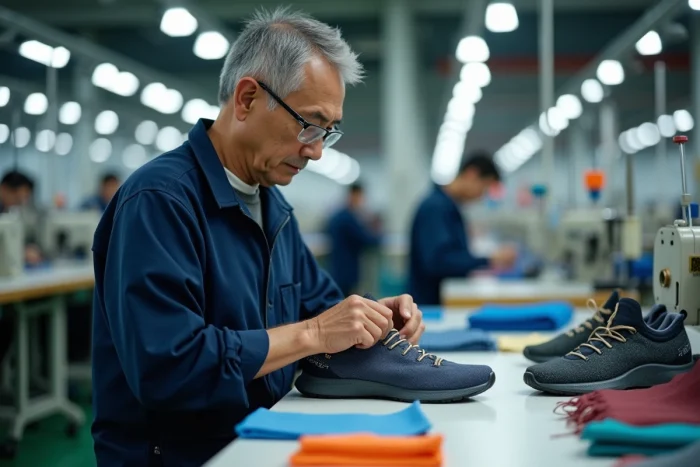
When you slip on a pair of Skechers, you’re stepping onto a product that has traveled across several continents before arriving in your closet. The brand, founded in 1992 in Manhattan Beach, California by Robert Greenberg, does not own any factories. All production relies on a network of subcontractors spread across Asia, a model that shapes the price, quality, and ethical issues of each pair.
Total outsourcing: the industrial model that defines Skechers
Have you ever noticed the “Made in Vietnam” or “Made in China” label on the inside of your sneakers? At Skechers, design is done in the United States, but all manufacturing is delegated to partner factories in Asia. This strategic choice, adopted from the early years, allows the brand to focus its resources on design and marketing.
What sets this model apart is the scale of the network. Skechers collaborates with dozens of suppliers, primarily in China and Vietnam. The company does not manufacture anything itself, which gives it a rare flexibility to adjust volumes according to demand. A successful model can be produced in large quantities without investing in new production lines.
To better understand the manufacturing of Skechers shoes, one must grasp this fundamental principle: the Californian brand orchestrates, but does not produce.
Vietnam and China: where are Skechers shoes actually assembled
For a long time, China was the main production hub for Skechers. That trend is changing. In recent years, the share of models made in Vietnam has significantly increased. More and more references display this country as the place of origin on product sheets and labels.
This migration is not unique to Skechers. The entire athletic shoe industry is seeking to reduce its dependence on China, due to trade tensions and increased tariffs imposed by the United States on Chinese products.
Why Vietnam is gaining importance
Vietnam offers competitive labor costs and favorable trade agreements with several Western markets. For a brand that sells affordable shoes, every saving on production costs directly impacts the final price in stores.
Skechers does not disclose the exact distribution by country. However, the geographical diversification of its suppliers allows it to limit risks associated with a single production area. If a trade conflict or health crisis disrupts one country, other factories can take over.
Quality control and materials: what happens in partner factories
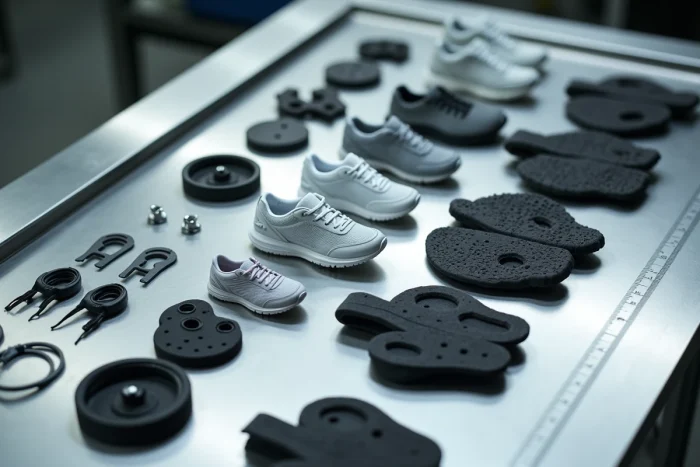
Delegating manufacturing does not mean relinquishing control. Skechers imposes a precise specification to its subcontractors. The manufacturing process of a pair follows codified steps, from cutting materials to final assembly.
The main assembly steps
- Cutting the upper pieces (the top part of the shoe) from synthetic textiles, breathable mesh, or leather depending on the model
- Sewing and gluing the upper to the midsole, often made of memory foam for comfort ranges
- Attaching the outsole, usually made of rubber or synthetic material, followed by visual and functional inspection before packaging
Proprietary technologies like memory foam soles are developed in-house by R&D teams in California. The foam formulas are passed on to partner factories, which integrate them into the assembly process according to strict technical specifications.
Ethical sourcing: the issue of forced labor in the Skechers supply chain
The massive outsourcing raises a question that the brand cannot evade: who actually makes these shoes, and under what conditions? In 2020, a report from the Australian Strategic Policy Institute (ASPI) highlighted the risk of Uyghur forced labor in certain Chinese factories linked to major international brands.
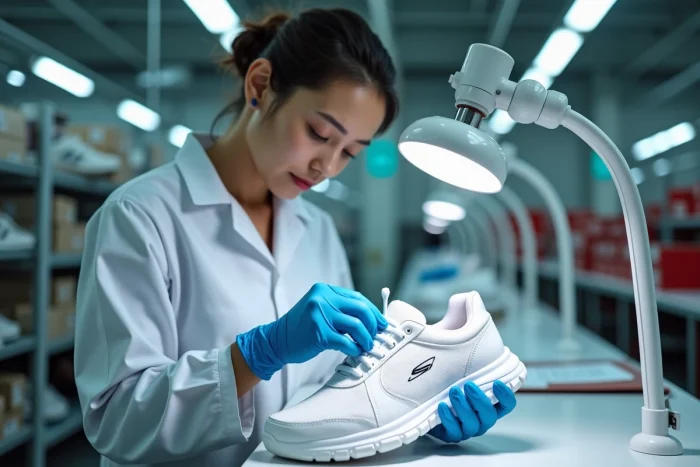
Skechers responded with an official statement. The brand claims not to source products, components, or cotton from Xinjiang. It states that it has strengthened its supplier audits and due diligence processes throughout its supply chain in China.
This positioning aligns with the Uyghur Forced Labor Prevention Act, in effect in the United States since 2022. This law imposes enhanced scrutiny on any product potentially linked to this region. For Skechers, this translates to:
- A Supplier Code of Conduct that every subcontractor must adhere to
- Regular audits of production sites to verify working conditions
- Documented traceability of raw materials used in manufacturing
Transparency remains partial. Skechers does not publish a complete list of its partner factories, unlike some competitors who have adopted a more open disclosure approach.
American design and Asian production: a common but not trivial model
The “designed in USA, made in Asia” scheme is not exceptional in the athletic shoe industry. Nike, Adidas, New Balance (for part of its range) operate on similar principles. What characterizes Skechers is the complete absence of in-house production, where other brands sometimes own a few sites.
This choice has allowed Skechers to become the second-largest athletic shoe brand in the United States, behind Nike. The ability to produce quickly, at lower costs, with a very broad catalog (from walking shoes to lifestyle models) relies entirely on this industrial flexibility.
For the consumer, the compromise is clear. The accessible price reflects an optimized production model, not artisanal or local manufacturing. Knowing where your shoes come from also means understanding why they cost what they do.