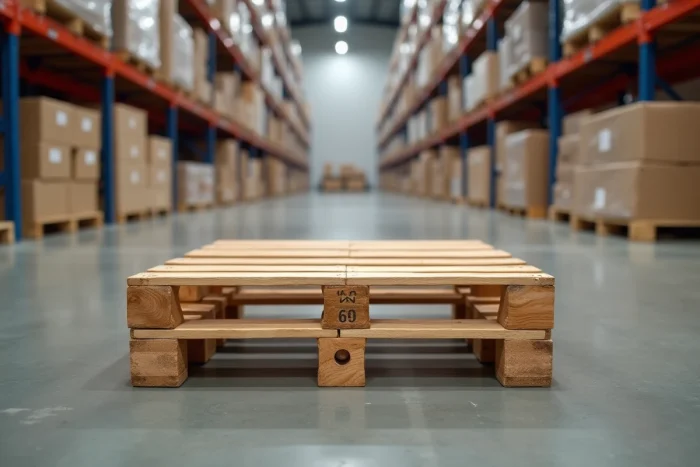
The Europe pallet measures 800 x 1200 mm. This format, managed by the European Pallet Association (EPAL), remains the most widely used on the continent for road, rail, and maritime freight. Its dominance is based on almost universal compatibility with handling equipment. But is this universality sufficient in the face of new demands from automated warehouses and the rising prominence of the 1000 x 1200 mm format in certain sectors?
Europe pallet and industrial pallet: format comparison in logistics
| Criterion | Europe pallet (EPAL) 800 x 1200 mm | Industrial pallet 1000 x 1200 mm |
|---|---|---|
| Usable area | 0.96 m² | 1.2 m² |
| Trailer saturation 13.6 m | 33 pallets (optimized layout) | Better saturation for light and bulky loads |
| Equipment compatibility | Almost universal in Europe | Common in industry, less so in distribution |
| Preferred sectors | Large distribution, multimodal transport | Agri-food, e-commerce (low-density cartons) |
| Reference standard | ISO 6780, EPAL certification | ISO 6780 (recognized format, no EPAL marking) |
The 800 x 1200 format remains the default choice for the majority of European flows. However, since 2022, several shippers in agri-food and e-commerce have reintroduced the 1000 x 1200 format into their logistics schemes. The reason is simple: for bulky but lightweight products, the industrial pallet allows for better filling of a standard 13.6 m trailer and reduces the cost per package.
To learn everything about the dimensions of a Europe pallet, it is important to understand that the choice between these two formats is not trivial: it determines the number of references per truck, the arrangement of racks in the warehouse, and the cost of the last mile.
EPAL dimensional tolerances in the face of automated warehouses
The nominal dimensions of the Europe pallet (800 x 1200 mm, height of about 144 mm) are framed by EPAL certification and the ISO 6780 standard. On paper, these specifications guarantee interchangeability among all links in the supply chain.
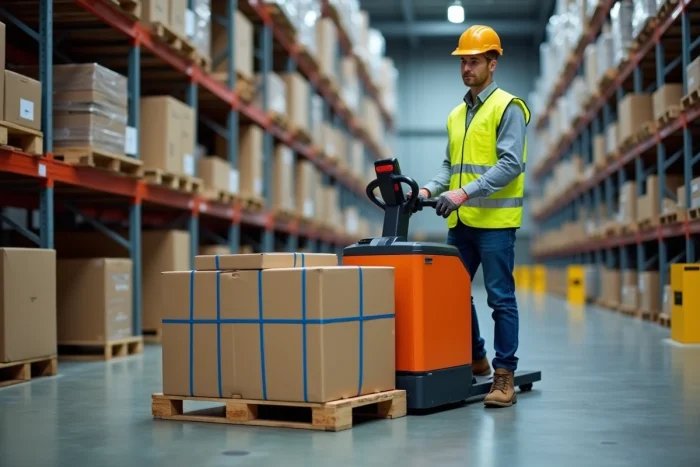
The reality of automated warehouses tells a different story. Since 2023, integrators like SSI Schäfer and Jungheinrich have reported that their stackers and shuttles require stricter tolerances than those defined by EPAL. Flatness, deformation of corners, localized over-thicknesses: these are micro-defects that go unnoticed in manual handling but cause blockages and failures in an automated system.
A gap between standards and reality
This increased requirement has not yet been integrated into official normative texts. It appears in the specifications of tenders for self-supporting warehouses since at least 2023. In practical terms, this means that an EPAL compliant pallet can be rejected by an automated system.
For operators, sorting pallets at the entrance of the warehouse becomes an additional cost item. Some opt for new pallets reserved for automated circuits, while used or refurbished pallets are redirected to manual flows. This dual circuit complicates fleet management.
- Flatness of the upper face: a criterion that has become discriminating for roller conveyors and guided shuttles
- Deformation of corner blocks: beyond a non-standardized threshold, automatic fork centering fails
- Condition of the lower soles: a chip or an over-thickness is enough to jam a stacker
Carbon footprint per unit shipped according to pallet format
The choice of pallet format directly influences the carbon footprint of a shipment. Recent life cycle analyses (LCA) compare the 800 x 1200 and 1000 x 1200 formats on this criterion.
The reasoning is arithmetic. A better-filled truck transports more goods per trip, which reduces the number of rotations and therefore emissions per unit shipped. For lightweight and bulky products, a partial shift to the 1000 x 1200 format generates a measurable gain on the carbon footprint of land transport.
Wood, plastic, and reuse
The EPAL wooden pallet remains predominant. Its lifespan depends on the number of rotations and the quality of refurbishment. Wood has the advantage of being repairable, which extends the usage cycle and limits waste.
Plastic pallets, lighter and insensitive to moisture, are gaining ground in the pharmaceutical and agri-food sectors. Their initial production is more energy-intensive, but their longer lifespan can offset this gap over a high number of rotations. The material matters less than the reuse rate in the overall environmental balance.
Europe pallet standard and trailer saturation: concrete trade-offs
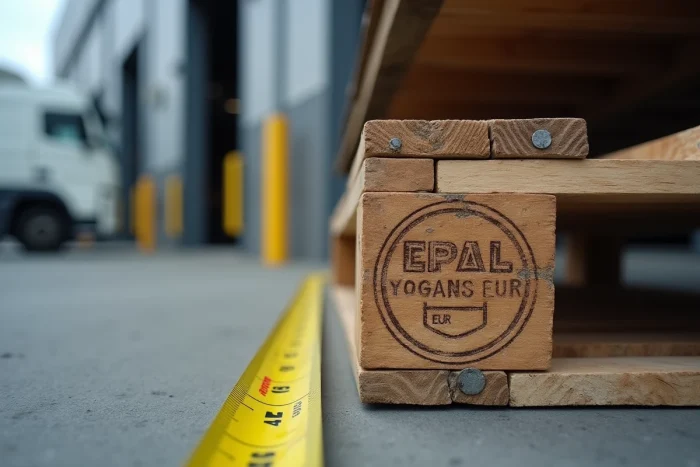
Optimizing the loading of a standard 13.6 m long trailer remains the primary objective of any transport manager. With EPAL pallets of 800 x 1200 mm, the classic layout allows for 33 pallets per trailer (11 rows of 3, alternating directions).
This figure assumes pallets in good condition and a homogeneous load. In practice, several factors reduce actual saturation:
- Load overflow beyond the perimeter of the pallet, which prevents tightening the rows
- Unused useful height under the ceiling, common with medium-sized packages
- Deformed or non-compliant pallets rejected at loading, creating empty spaces
Standardization of dimensions does not guarantee truck saturation. It makes it possible, provided that the entire chain (packaging, palletization, quality control of supports) is aligned on the same level of requirement.
The 800 x 1200 mm format remains the common denominator of European logistics. Its partial challenge by the 1000 x 1200 format in certain flows, combined with the new constraints of automated warehouses, shows that the dimension of a pallet is never a closed subject. The trade-off between universal compatibility and sector optimization is now played out pallet by pallet, flow by flow.