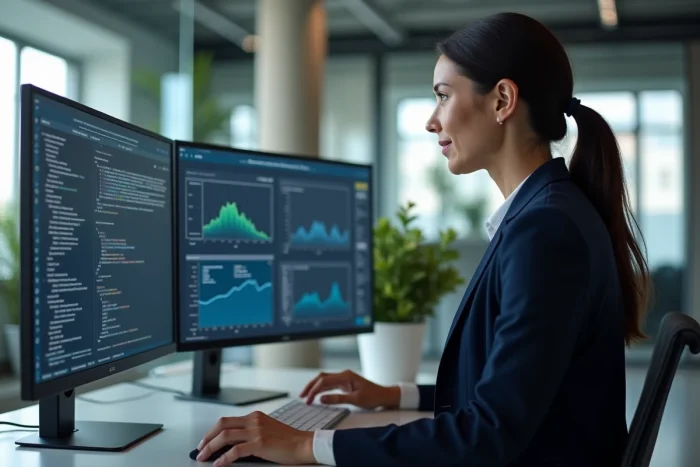
A custom IT solution refers to a set of software and hardware specifically designed to meet the processes of a business, as opposed to standard market tools. This type of solution encompasses both business applications and infrastructure monitoring, data management, or the automation of recurring tasks. The technical challenge lies in the alignment between the chosen architecture and the actual operational constraints of each organization.
Digital resilience and the DORA regulation: what changes for IT solutions in 2025
The European regulation DORA (Digital Operational Resilience Act), applicable since January 17, 2025, imposes new requirements regarding business continuity and incident traceability. Although this text primarily targets the financial sector, its ripple effect impacts all IT service providers and their indirect clients.
In practical terms, a custom IT solution project must now integrate mechanisms for monitoring third-party suppliers, incident logging, and recovery plans right from its design phase. Any company working with actors subject to DORA is, in fact, required to document the resilience of its own systems.
This regulatory framework modifies the specifications well before the first line of code. It is no longer sufficient to deliver a functional application: the ability to trace, audit, and restore becomes a contractual prerequisite. Companies wishing to discover Cydlab services can assess how this dimension is taken into account in a structured professional support.
Cybersecurity integrated into custom solutions: an often-overlooked angle
The European Union Agency for Cybersecurity (ENISA) highlights in its Threat Landscape 2025 report the increased exposure related to software dependencies and third-party integrations. For a custom IT solution, this means that every added component (API, connector, external module) represents a potential attack surface.
Many custom projects focus on business functionalities without a dedicated budget for security. However, vulnerability management should be part of the initial scope.
Control points to integrate from the design phase
- Audit of software dependencies: every library or third-party component must be listed, with tracking of security updates and known vulnerabilities
- User access segmentation: define granular rights levels to limit the impact of an account compromise on the entire system
- Penetration testing before production: simulating attacks on the application helps identify vulnerabilities before they are exploited in real conditions
- Incident response plan: document detection, isolation, and remediation procedures to reduce response time in case of a breach
Integrating these elements from the start is cheaper than correcting a vulnerable architecture after deployment. Security is not an added layer; it is a design constraint.
Generative AI in business software: framing usage rather than automating everything
The integration of generative AI into custom IT solutions is progressing rapidly. The IBM Cost of a Data Breach 2025 report shows that companies are now directing these tools towards framed uses rather than generalized automation.
The nuance matters. Deploying a language model to summarize technical support tickets or categorize incoming data provides measurable gains. Allowing the same model to make decisions without human supervision on critical processes (order validation, financial arbitration) exposes the organization to costly errors.
Identifying relevant use cases
A good selection criterion: generative AI works best on tasks where the error is reversible. Drafting a customer response can be corrected before sending. Automated writing in a production database, much less so.
For SMEs, a common pitfall is wanting to integrate AI as a trend without stabilizing the underlying processes. If data management is not structured, no algorithm will compensate for the disorder. The priority remains to have a clean infrastructure, with documented data flows, before connecting intelligent components.

Infrastructure monitoring and performance: measure before optimizing
The performance of a custom IT solution is not decreed. It is measured through concrete indicators: application response times, service availability rates, volume of incidents per period. Without monitoring tools, this data remains invisible.
Monitoring covers three complementary levels:
- Infrastructure (servers, network, storage): detect resource saturations before they affect users
- Business applications: track processing times of key operations, identify bottlenecks in workflows
- Real user experience: measure what the end user perceives, not just what the server reports
These three levels do not provide the same alerts. A server may show normal load while an application request takes several seconds to complete on the user side. Application monitoring and infrastructure monitoring must work together to provide a reliable picture of performance.
Dashboards and alert thresholds
Configuring alert thresholds tailored to the business context avoids two pitfalls: noise (too many insignificant alerts that end up being ignored) and blind spots (no alerts on a critical indicator). An effective dashboard displays fewer than ten metrics, chosen based on the company’s priority operations.
IT teams monitoring custom solutions benefit from cross-referencing technical data with business indicators. A slowdown of a few milliseconds on an internal consultation page does not have the same impact as an equivalent slowdown on a customer order tunnel.
The choice of a custom IT solution commits a company for several years. Recent regulatory constraints, particularly DORA, and the rapid evolution of threats documented by ENISA require treating resilience and security as technical components of the project, alongside business functionalities. Monitoring remains the only way to verify that the promised performance translates into actual performance on a daily basis.