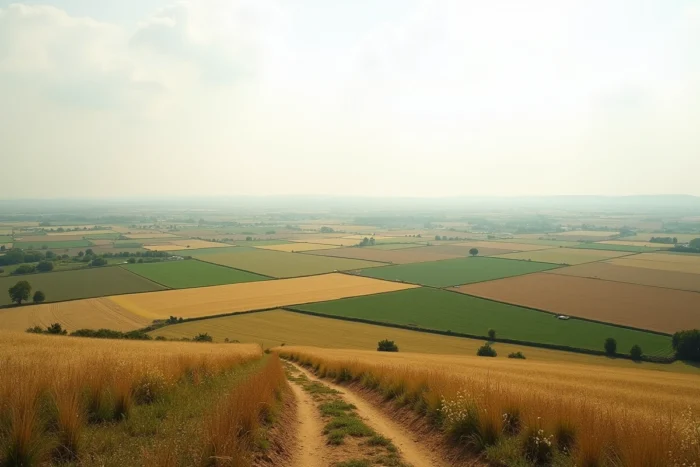
50 hectares is 500,000 square meters. The figure is clear on paper, but our spatial perception does not work in square meters. We work daily with areas of this size in land, agricultural, and planning contexts, and the difficulty of projection remains the same for professionals as it does for project holders.
50 hectares and useful agricultural area: a professional land reference
The 2020 Agricultural Census sets the average useful agricultural area per farm in metropolitan France at 69 hectares. A block of 50 hectares therefore represents about three-quarters of a typical French farm. This ratio immediately resonates with anyone who has ever walked through a grain farm in Beauce or a cattle farm in Normandy.
In the Shift Project’s documents on low-carbon agriculture (report published in January 2025), the unit of a few dozen hectares serves as a modeling unit for scenarios of reconfiguring livestock systems or perennial crops in a watershed. Therefore, 50 hectares is not an arbitrary figure: it is an operational magnitude in territorial planning.
To understand precisely what 50 hectares correspond to, we need to go beyond sports analogies and anchor this area in measurable land realities.
Calibrated visual comparisons for 50 hectares
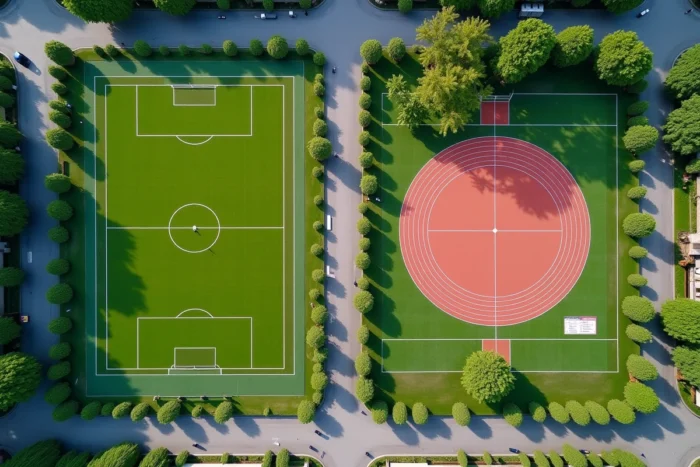
Comparisons with football fields are everywhere, and for good reason: a field of regulatory dimensions (about 0.7 hectare) provides an easy-to-remember ratio. 50 hectares is roughly equivalent to 70 football fields lined up. The problem is that no one has ever seen 70 fields side by side.
We prefer references that correspond to spaces that are actually usable.
Urban and landscape references
- The Luxembourg Garden in Paris covers about twenty hectares. Two Luxembourg Gardens end to end represent the area to visualize, including its paths, ponds, and forested areas.
- A square of 707 meters on each side produces 50 hectares. In an urban context, this is a distance that a walker covers in eight to ten minutes at a normal pace, in each direction.
- A dense residential neighborhood (plots of 300 to 500 m²) accommodates between 1,000 and 1,600 houses on 50 hectares, excluding roads and common spaces. This is the scale of a small town or a suburban housing development.
Agricultural and forestry references
A classified Bordeaux vineyard can occupy several dozen hectares for a single estate. 50 hectares of producing vineyard is a medium-sized estate, sufficient to ensure bottling at the chateau and short distribution.
In large crops (wheat, rapeseed, corn), 50 hectares correspond to a modest but autonomous area, meaning a block that a grain farmer can harvest in two to three days with standard equipment.
Common mistakes in estimating areas of 50 hectares
The confusion between hectare and square kilometer remains the most common trap. 50 hectares is 0.5 km². Half a square kilometer. Many administrative documents mix the two, which skews the orders of magnitude by a factor of 100.
Another recurring mistake: mentally projecting a very elongated rectangle. 50 hectares arranged in a band 100 meters wide extend over 5 kilometers long, a common configuration along rivers or railways. The same area in a square only measures 707 meters on each side. The shape of the land radically changes the perception of the area.
In land transactions, we observe that buyers systematically underestimate areas as soon as they exceed ten hectares. The perceptual leap between 10 and 50 hectares does not happen naturally because our daily experience is limited to spaces of a few thousand square meters (housing, garden, parking).
Quick conversion table around 50 hectares
| Area | Square meters | Square kilometers | Ares |
|---|---|---|---|
| 10 hectares | 100,000 m² | 0.1 km² | 1,000 ares |
| 25 hectares | 250,000 m² | 0.25 km² | 2,500 ares |
| 50 hectares | 500,000 m² | 0.5 km² | 5,000 ares |
| 69 hectares (average French farm) | 690,000 m² | 0.69 km² | 6,900 ares |
| 100 hectares | 1,000,000 m² | 1 km² | 10,000 ares |
This table highlights the constant ratio: divide hectares by 100 to obtain km², multiply by 10,000 for square meters. The line at 69 hectares serves as an anchor point with the agricultural reality in France.
Using the right scale according to land context
At 50 hectares, we are in an intermediate zone where neither the square meter nor the square kilometer is really practical. The square meter produces six-digit numbers, while the square kilometer gives decimals that are not very meaningful. The hectare remains the reference unit for the cadastre, urban planning, and real estate transactions in France.
In land prospecting, we recommend always converting the announced area into a known physical reference for the interlocutor. For a local elected official, compare with the area of their town center. For a farmer, relate it to the existing parcels. For an urban investor, bring it back to a number of buildable lots after deducting roads and public spaces.
50 hectares is a sufficient area to support a structuring project (business zone, photovoltaic park, viable agricultural operation) but not so vast as to lose the connection with the human scale. This is precisely what makes it a relevant project unit in land development.