A wedding slideshow is a sequence of photos and sometimes short videos, projected in front of guests during the reception. Its duration depends on three technical variables: the number of selected photos, the display time per image, and the duration of transitions between each shot. Understanding these parameters allows for calibrating the projection so that it remains an emotional moment without becoming a visual tunnel.
Venue and service constraints: the framework the slideshow must adhere to
Before deciding how many photos to include, it is essential to check what the reception venue allows. Several high-end venues and caterers in France now include a time limit for projected animations in their technical sheets. This cap covers all projections (slideshow, videos, filmed speeches) and often falls within a block of ten to fifteen minutes in total.
This constraint exists for a concrete reason: a slideshow that is too long delays kitchen service. The caterer schedules their dish deliveries on a tight timeline. A projection that overruns by five minutes pushes back the starter or main course, cools the plates, and disrupts the floor staff.
If the venue imposes a global block, the slideshow must share this time with other animations. A three-minute filmed witness speech, for example, reduces the available window by that much. Requesting the venue’s technical sheet before finalizing the edit prevents having to cut photos the night before, and this is a reflex that wedding planners also recommend, as can be learned more about on La Mariée Rêveuse on this subject.
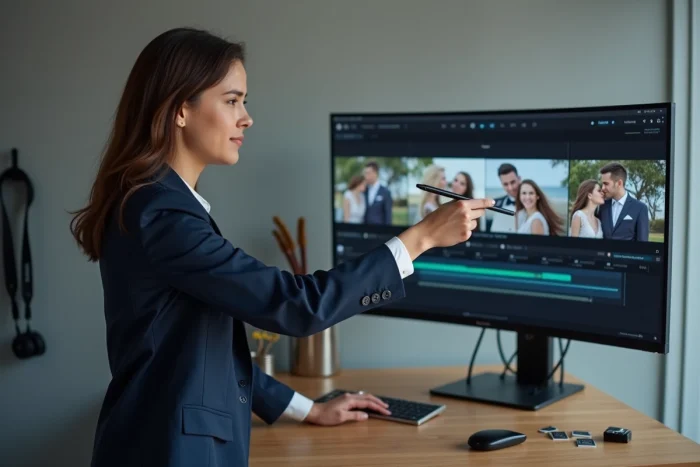
Duration of the wedding slideshow: the concrete calculation photo by photo
The mechanics are simple. Each photo remains visible for between three and five seconds, including transitions. Below three seconds, the eye does not have time to recognize faces. Beyond five seconds, the rhythm collapses and attention wanes.
Based on this foundation, the calculation is quick:
- For a five-minute projection (short format), count between sixty and one hundred photos with an average display of four seconds per image.
- For a projection of eight to ten minutes (standard format), plan for between one hundred twenty and one hundred fifty photos, varying the pace between rapid sequences and pauses on strong shots.
- Beyond ten minutes of pure projection, most guests lose interest, especially if the slideshow is shown after speeches or late in the evening.
An effective wedding slideshow lasts between five and ten minutes. This is the range most often cited by professional videographers and in feedback from specialized forums. This format allows time to cover the childhood of both spouses, their meeting, and the couple’s significant moments without overwhelming the audience.
Placement in the evening: the timing changes the perceived duration
The same eight-minute slideshow does not produce the same effect when projected at 8:30 PM or 11:30 PM. Wedding planners have noticed a clear trend since the post-Covid recovery: placing the slideshow earlier in the evening, often before the main course or just after the starter.
The reason is physiological. After several hours of celebration, toasting, and speeches, attention capacity drops. A slideshow scheduled late, in a dark room where guests have already danced, becomes a moment of drowsiness rather than emotion.
Placed early, the slideshow benefits from an audience that is still attentive and sober. It then fits into a unique block of highlights (witness speeches, projection, possibly a short video) that does not exceed fifteen minutes in total. This early placement also encourages shortening the projection: there is no need to fill time, as the evening’s program is still dense.
The mistake of a two-part slideshow
Some couples choose to split the projection into two blocks (childhood, then couple life) shown at different times during the evening. On paper, this seems to reduce the perceived duration. In practice, it poses two problems: guests who step away between the two parts lose the narrative thread, and the DJ or host must regain attention twice, which disrupts the rhythm of the celebration.
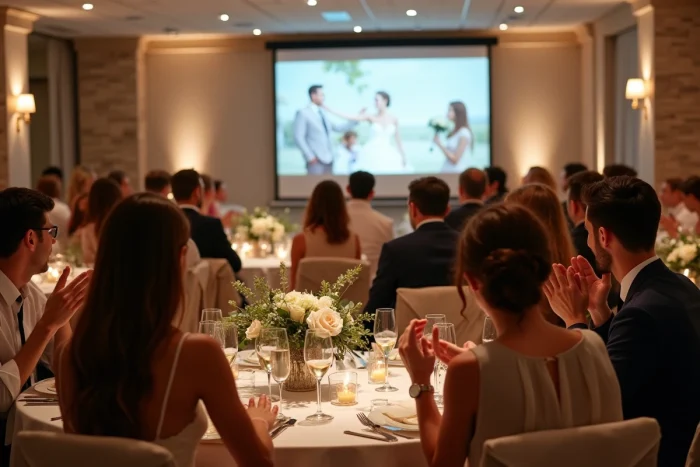
Editing the slideshow: three technical choices that change the duration
The number of photos is not the only lever. Three editing decisions have a direct impact on the final duration and on the guests’ perception.
Music and synchronization
The music track dictates the rhythm. Aligning the slideshow with two pieces of music (one slow, one more upbeat) provides a natural framework of six to eight minutes. Adding a third piece extends the projection beyond ten minutes, often exceeding the comfortable attention threshold.
Transitions between photos
Fades and transition effects add between half a second and two seconds per image. For one hundred photos, this represents up to three additional minutes. Simple transitions (fade, hard cut) maintain a smooth rhythm. Complex effects (3D rotation, animated zoom) slow down the projection and quickly become outdated.
Short version for social media
The demand for short versions of the slideshow, designed to be reshared on social media after the wedding, has significantly increased since the rise of short formats like Reels or TikTok. This condensed version lasts between one and three minutes and selects the strongest shots. It does not replace the projection on the big day, but it forces the identification of priority photos, which helps in sorting the main slideshow.
A successful wedding slideshow relies less on the abundance of photos than on the rigor of selection. Checking the venue’s technical sheet, aligning the duration with two pieces of music, and projecting early in the evening are the three decisions that, combined, make the difference between a suspended moment and a projection that guests endure.