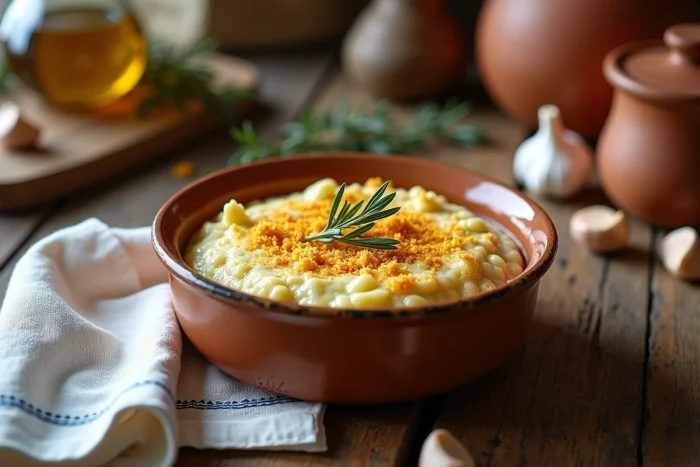
The Nîmes brandade relies on three ingredients (cod, olive oil, milk) and a precise technical gesture. However, the discrepancies between the recipes published online are significant, both in terms of proportions and the emulsification method. How can these variations be explained for such a codified dish, and what differences do they produce on the plate?
Manual or mechanized emulsification: what changes the texture of brandade
Several Nîmes workshops have shifted since 2022 to a partially mechanized emulsification, using paddles or ribbon mixers. The finishing remains manual, with a spatula. Trials of fully mechanized production have shown a result deemed non-compliant by artisans: the brandade loses its stretchiness and becomes pasty.
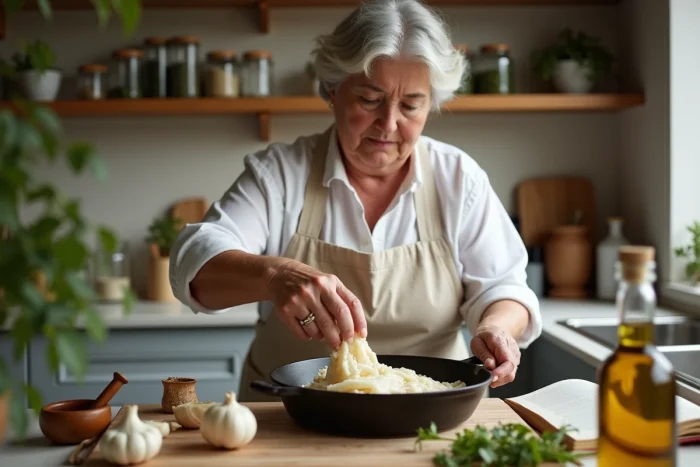
This technical point distinguishes Nîmes brandade from a simple fish puree. The gesture of “brander” (stirring in Provençal) aims to achieve an airy emulsion, similar to a thick mayonnaise. The spatula or wooden spoon allows for control over the speed of incorporating olive oil and milk, which determines the final consistency.
The Nîmes brandade recipe by Michel Sarran illustrates this approach well, where the chef’s hand remains the main tool for preparation, in contrast to the shortcuts offered by machines that most mainstream recipes attempt.
Proportions of cod, olive oil, and milk: comparison of traditional recipes
The recipes for Nîmes brandade mainly diverge on the ratios between the three basic components. The table below compares the approaches noted in the available sources.
| Source / Approach | Desalted cod | Olive oil | Milk | Potato |
|---|---|---|---|---|
| Chef François Recipe (Gard) | 400 g | 20 cl | 10 cl | Absent |
| Low-end industrial versions | Reduced proportion | Variable (mixed oils) | Variable | Often present |
| Public recipes (like puree) | Variable | Low | High | Frequent |
The traditional Nîmes brandade does not contain potato. This is the clearest dividing line between the Gard version and the adaptations found elsewhere in France. Adding potato changes the texture and flavor: it results in a heavier, less subtle dish, where the cod takes a back seat.
The proportion of olive oil is the other key variable. In Chef François’s recipe, the oil/milk ratio is 2 to 1. Reducing the olive oil results in a drier outcome. Increasing the amount without mastering the speed of incorporation causes the emulsion to separate.
Specifications “Signé Gard” and salted cod: the naming constraints
Since 2023-2024, “Brandade de Nîmes” has been subject to official regulation within the “Signé Gard” initiative, supported by the Gard Department and the Chamber of Agriculture. The specifications impose two main constraints:
- Exclusive use of salted cod, no fresh fish or unsalted frozen cod. The salting and subsequent desalting are integral to the process and alter the structure of the fish’s proteins, facilitating emulsification.
- Production localized in the Gard to claim the territorial logo on sales materials.
- Adherence to a documented artisanal process, excluding formulations with additives or thickeners.
This regulation addresses a concrete issue. Nîmes producers have reported since late 2022 a strain on stocks of North-East Atlantic cod, linked to reduced quotas by the EU fishing ministers’ council. The consequences are direct: increased material costs and diversification towards other sources of salted cod. Low-end industrial versions tend to reduce the proportion of fish, further distancing the product from the traditional recipe.
Desalting the cod: the parameter that most recipes underestimate
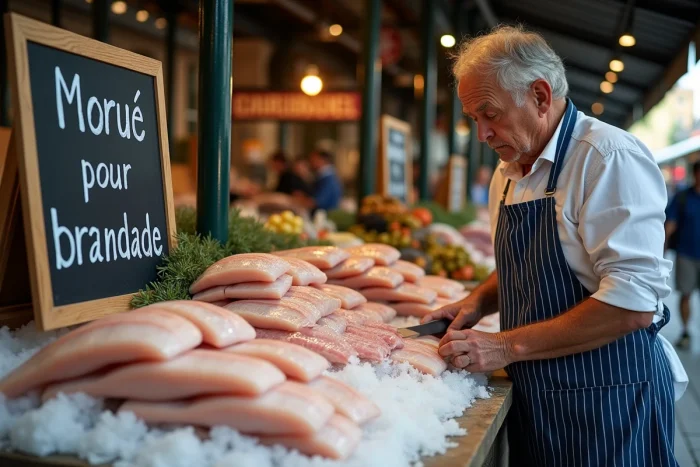
Desalting is as crucial to the final result as cooking. Insufficiently desalted cod makes the dish inedible. Over-desalting deprives the fish of its firm texture and characteristic flavor.
The standard method involves immersing the cod in a large volume of cold water, renewed several times over an extended period (usually the day before preparation). The water must remain cold to prevent any cooking or bacterial proliferation.
- Cutting the cod into pieces before desalting speeds up the process but requires closer monitoring of the salt level.
- Tasting a small raw piece after desalting allows for checking that the residual salt is just enough to season the dish without additional salt.
- The skin and bones are removed after poaching, when the flesh easily flakes apart.
Poaching: low temperature, never boiling
The cod is poached in a mixture of water and milk with a bay leaf and a clove of garlic. The liquid must not boil: a simmer is enough to cook the flesh without hardening it. A vigorous boil dries out the fibers and complicates the emulsification process.
Once the cod is poached and flaked, the warmed olive oil is gradually incorporated, alternating with the hot milk. It is this alternation, performed with a spatula, that creates the emulsion and gives the brandade its creamy white color and silky consistency.
Nîmes brandade at the table: pairing with Gard wines
Brandade is traditionally served warm, as a main dish or as an appetizer (to stuff vegetables or zucchini flowers depending on the season). However, when gratinéed in the oven with a drizzle of olive oil, it pairs well with slightly more structured wines.
The dry whites from Gard, particularly those from the southern Rhône valley, work well with the creaminess of the dish. The acidic freshness of the wine balances the richness of the olive oil. A rosé from Costières-de-Nîmes remains a classic and local option that does not betray the dish’s profile.
The authentic Nîmes brandade consists of three ingredients and one gesture. The “Signé Gard” framework formalizes what artisans have long practiced, at a time when pressure on raw materials makes the distinction between traditional products and industrial versions more visible than ever.