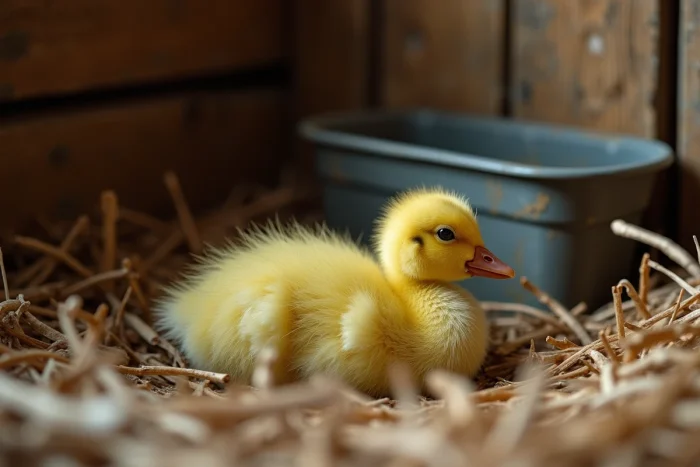
When raising goslings a few days old, the first challenge is not feeding them, but understanding how quickly their bodies change. In just a few weeks, a small yellow down gives way to waterproof plumage, their legs grow longer, and their behavior shifts from fearful gregariousness to territorial goose. Knowing the stages of a gosling’s growth allows for the adaptation of feeding, habitat, and water management at each phase, without improvisation.
Orthopedic risks related to the growth rate of the gosling
This is rarely mentioned in general breeding guides, but the growth of the gosling presents a concrete mechanical problem. Research published by Utrecht University on ornamental waterfowl shows that goslings fed continuously with very rich rations develop more leg deformities (valgus, varus, lameness) as early as the third or fourth week of life.
The mechanism is straightforward: long bones grow faster than tendons and ligaments can keep up. Joints become deformed under the weight of the body, especially in heavy breeds like the Toulouse goose or the Embden goose.
The solution identified in this research is to gradually reduce the energy density of the ration after the third week, without affecting the final adult weight. One transitions from a high-protein starter feed to a less concentrated growth formula, while simultaneously increasing access to grass. To better understand each phase, consulting the growth stages of the gosling helps adjust the feeding schedule. This transition, often rushed or overlooked, protects the joints without hindering development.
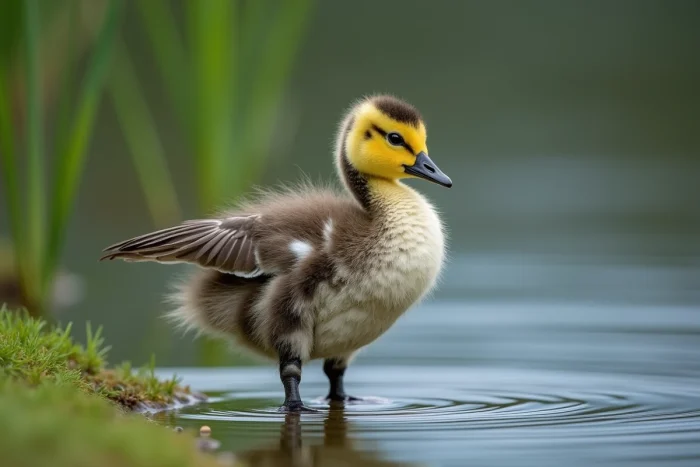
Access to bathing water: a specific constraint for goslings
Goslings are not chicks. Their relationship with water is different from the very first days, and mismanaging this aspect creates long-term plumage problems.
The recommendations from the Federation of Veterinarians of Europe (FVE, updated guidelines on poultry welfare) advocate for early but strictly controlled access to bathing water for young waterfowl. In practice, this means shallow tubs, with a gentle slope so that the gosling can enter and exit on its own, and limited bathing time during the first weeks.
Why not wait for complete plumage
The down of the gosling is not waterproof. One might think it’s better to wait for the growth of real feathers before allowing bathing, but feedback on this point varies. What the FVE emphasizes is that early access to water reduces stress behaviors and improves the quality of adult plumage. A gosling that learns to get wet early stimulates its uropygial gland, which produces waterproofing sebum.
In practice, bathing begins around the end of the first week with a few minutes of supervised bathing in a shallow tub. After the fourth week, when the down gives way to the first contour feathers, bathing time can gradually increase.
Feeding the gosling: transitions not to miss
The growth of the goose is divided into distinct feeding phases, and each poorly managed transition results in developmental delays or locomotor disorders.
- From hatching to the third week: high-protein starter feed, provided with nearly free access. The gosling eats frequently, in small amounts. Drinking water must be clean and changed several times a day, as goslings constantly dip their beaks in it.
- From the third to the eighth week: transition to a less energy-dense growth feed. Fresh grass is introduced, which the gosling quickly learns to graze. This phase is when reducing energy density protects the legs without compromising weight gain.
- After two months: the gosling becomes a young adult capable of primarily feeding on grass, supplemented by maintenance feed. The beak is sufficiently developed to tear and grind fibrous plants.
Grass as a natural regulator
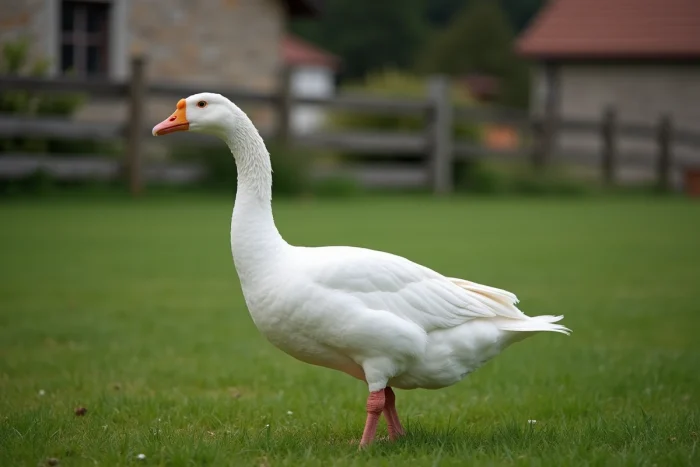
The goose is a herbivore by nature, which clearly distinguishes it from chickens. A gosling that has early access to a pasture naturally slows its concentrated feed intake. It grazes, selects young shoots, and this fiber intake balances the ration without additional intervention.
On a non-grassy terrain (indoor farming, concrete runs), one compensates with cut greenery, but the result is not equivalent. The act of grazing itself, moving around, and selecting blades contributes to the proper muscular and joint development of the legs.
Sexual maturity and adult behavior of the goose
The goose reaches sexual maturity between the fifth and ninth month, depending on the breed and rearing conditions. The gander begins to show territorial behaviors well before: upright posture, hissing, attempts to dominate peers.
In female geese, the first signs of maturity are more subtle. One observes a gradual widening of the pelvis, a change in vocalization, and a tendency to explore dark corners of the coop or shelter, indicating she is looking for a nesting site.
- Visual sexing remains difficult in breeds where males and females have the same plumage. Beak size, posture, and voice (deeper in ganders) provide clues, but certainty comes from examining the cloaca or observing behavior during the breeding season.
- The adult gander generally weighs more than the goose, with a thicker neck and a more upright posture.
- The first laying rarely occurs before the spring following the year of birth, even if the goose appears physically mature beforehand.
The domestic goose lives longer compared to other poultry. A well-fed animal protected from predators can remain productive for many years. This longevity justifies the attention given to the first weeks: growth errors, particularly in joints, accompany the animal throughout its life.