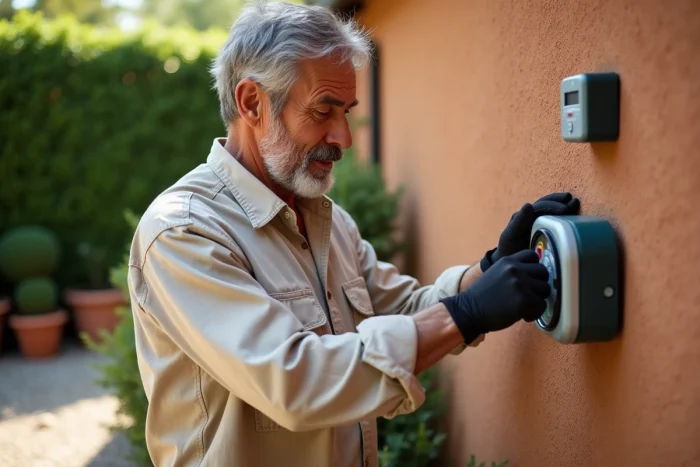
Your irrigation programmer shows a low battery indicator even though you recharged it just a few weeks ago. This scenario occurs every summer in gardens equipped with automatic systems. The problem rarely comes from the batteries themselves, but from how the programmer uses them on a daily basis.
Sealing of the housing and corrosion of contacts: the primary factor in battery wear
Before discussing battery brand or technology, check the physical condition of the compartment. A damaged cover seal or a poorly tightened cable gland allows moisture to enter. Water seeps in, oxidizes the metal contacts, and creates parasitic electrical resistance.
The programmer then has to provide more energy to compensate for this resistance. The result: batteries that drain without apparent reason.
Rain Bird recommends in its European technical bulletins to check the housing’s sealing with every battery change. Orbit and Gardena make the same recommendation in their recent manuals. Specifically, optimizing the battery life starts with a simple action: inspect the seal, clean the contacts with a dry cloth, and replace the seal as soon as it shows signs of cracking.
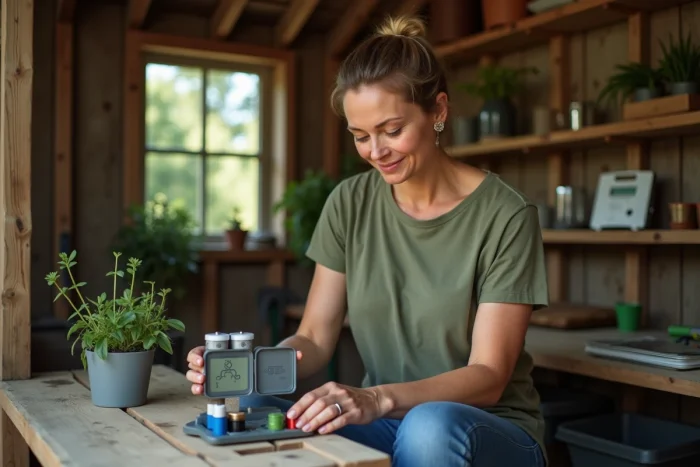
Disable Bluetooth or radio scanning to save the programmer’s battery
Do you have a connected programmer that works via Bluetooth or through a Wi-Fi gateway? Its battery powers not only the opening of the valves but also a communication module. This module regularly searches for a signal, even when you are not using the app.
This constant signal searching consumes energy continuously. On a purely mechanical model, the battery only works when activating the solenoid valve. On a connected model, it also works between waterings.
Energy-saving mode, a setting often overlooked
Galcon and Orbit have been offering energy-saving profiles in their mobile apps for a few years. These profiles reduce the frequency of synchronizations with the cloud and disable the constant Bluetooth scanning.
Disabling the constant signal search significantly increases battery life. Keep this in mind if you program your cycles once a week and do not need real-time communication.
- In the Orbit B-hyve app, look for the option to reduce cloud synchronizations in the advanced settings.
- On Galcon Bluetooth programmers, the manufacturer’s FAQ details the steps to limit automatic connections.
- For models with a Wi-Fi gateway, moving the gateway away from the programmer increases the number of connection attempts and thus consumption: bring it closer if possible.
Programming watering cycles: fewer starts, more autonomy
Every time your programmer opens a solenoid valve, it consumes a peak of energy. This peak is brief, but it repeats with each cycle. Three short waterings per day put more strain on the battery than a single long watering.
Hunter Industries documented this phenomenon in a technical paper presented at the Irrigation Show 2022. Their recommendation: group waterings into fewer but longer cycles when the soil type and plants allow it.
A concrete example in the garden
Imagine a vegetable garden watered three times a day for ten minutes. Switching to a single thirty-minute cycle in the morning reduces the number of solenoid valve activations from three to one. The amount of water remains the same, but the battery experiences only one peak consumption instead of three.
This grouping is not always possible. A lawn in full sun on sandy soil absorbs water quickly and may require split applications. Adjust the number of cycles to your situation, keeping in mind that each start costs energy.
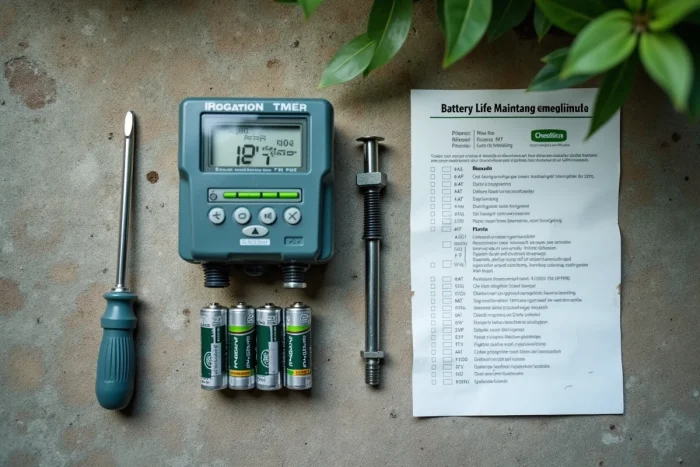
Alkaline, lithium, or rechargeable batteries: which type to choose for an irrigation programmer
The choice of battery type directly influences the programmer’s autonomy. Not all batteries react the same way to external conditions.
- Alkaline batteries: the most common and least expensive. They are suitable for standard use, but their voltage gradually drops, especially in hot weather. Their performance also decreases in cold weather.
- Lithium batteries: they maintain a stable voltage longer and handle temperature fluctuations better. Their cost is higher, but their service life often compensates for the price difference over a full season.
- NiMH rechargeable batteries: their nominal voltage is slightly lower than that of alkaline batteries. Some programmers interpret this lower voltage as a low battery signal, even when the charge is sufficient. Check compatibility in your model’s manual before switching to rechargeables.
For a programmer installed outdoors and exposed to high summer temperatures, lithium offers the best voltage stability. For indoor or sheltered use, good quality alkalines are sufficient.
Winterizing the programmer: protecting the batteries off-season
Leaving batteries in an unused programmer for several months encourages self-discharge and the risk of chemical leakage. An alkaline battery that leaks leaves a corrosive deposit on the contacts, which can permanently damage the compartment.
Remove the batteries at the end of the watering season. Store them in a dry place at room temperature. Take the opportunity to clean the contacts of the compartment with a cloth soaked in white vinegar if you notice early signs of oxidation, then dry thoroughly.
In the following spring, install new batteries and check the housing seal before restarting the programming. This seasonal ritual takes a few minutes and prevents most power-related failures.
The irrigation programmer remains an energy-efficient device. Batteries that drain too quickly almost always signal a problem with sealing, excessive communication, or overly fragmented cycles. Correcting these three points is usually enough to restore normal autonomy throughout the season.