
During a sale, renovation, or extension, finding the plans of one’s house becomes a priority. The notary is one of the first contacts that homeowners reach out to, sometimes mistakenly. This is because the notary is not legally required to keep detailed plans of a property. Their role is limited to the minutes of the deed and its annexes, among which architectural plans are not systematically included.
What the notary actually keeps in their real estate archives
The notarial file of a sale contains the authentic deed, mandatory diagnostics, easements, and references for planning permissions. Construction plans are only annexed if the seller or the project manager provided them at the time of signing.
In practice, older files (before the 2000s) rarely include plans. The notary kept the minutes and returned the technical documents to the seller. For more recent transactions, dematerialization changes the situation: some firms now use digital safes like the Minutier Central Électronique des Notaires de France (MICEN), where digitized plans can be archived with the deed.
Before undertaking any steps, it is useful to know precisely what the notary can or cannot provide. A detailed guide explains how to request the plans of one’s house from the notary depending on the date of the last sale and the type of property.
The notary is still required to inform the buyer of the references for building permits and prior declarations included in the deed. This obligation does not guarantee access to the plans themselves, but it provides the necessary file numbers to find them elsewhere.

Building permits at the town hall: the most reliable way to retrieve plans
The town’s urban planning service archives the building permit files submitted within its territory. These files contain site plans, cross-sections, facades, and sometimes interior layout plans.
Buildings constructed after the 1950s are almost always documented in municipal archives. For older buildings, preservation depends on local archiving policies, and gaps are common.
To make the request, simply go to the urban planning service with an ID and proof of ownership (title deed or property tax). Building permit files are administrative documents that can be disclosed, including to third parties, under the Code of Relations between the Public and the Administration.
- Prepare the cadastral parcel number of your property, available for free on the cadastre.gouv.fr website, to speed up the search at the town hall
- Also request any modification permits or prior work declarations, which document extensions or renovations made after construction
- If the town hall no longer has the archives, it can direct you to the departmental archives, where files are transferred after a certain retention period
Cadastral and departmental archives: supplements or alternatives to the notary
The online cadastre (cadastre.gouv.fr) allows you to consult the parcel plan of a piece of land for free. This document shows the boundaries of the property and the footprint of the building, but it does not reproduce interior plans or technical sections. Its usefulness remains limited for those looking for room layouts or structural details.
The departmental archives provide a complementary source, particularly for older houses. They preserve the records of former municipalities, Napoleonic cadastral matrices, and, in some departments, records from local architects.
Consultation can be done on-site or by correspondence. Response times vary by department, from a few days to several weeks. Some archives have digitized part of their collections, accessible online.
What to do when no plans can be found
For very old houses or those whose administrative files have been lost (fires, floods, war destruction), no institutional source holds the plans. Field reports vary on this point: some homeowners eventually find documents with former neighbors in the subdivision or with the original builder, while others do not.
Having new plans drawn up by a land surveyor or architect remains the only reliable option. The land surveyor conducts an accurate survey of the surfaces, dimensions, and load-bearing structure. The architect can, based on this survey, produce plans that comply with the standards required for a building permit or prior declaration.
This process has a cost, varying according to the size of the property and the complexity of the building. It offers an advantage that original plans do not always provide: the survey reflects the current actual state of the house, including unreported modifications made by previous owners.
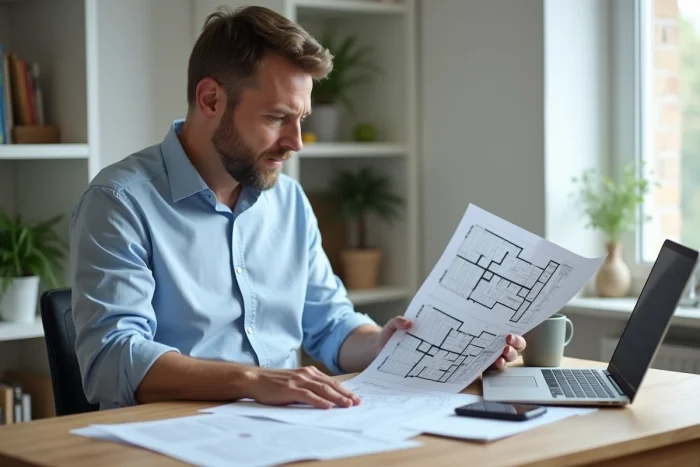
Real estate sale and plans: what the buyer can demand
No text obliges the seller to provide the plans of the house during a sale. The authentic deed mentions the area (Carrez law for co-ownership lots), technical diagnostics, and easements, but not the architectural plans.
A prudent buyer can ask the notary, before signing the preliminary agreement, to check if any plans are included in the sale file or in the study’s archives. If the property has been subject to a recent sale with digital archiving, the chances of obtaining usable documents increase.
- Ask the seller about the existence of plans kept at their home or with the former builder
- Check with the property management (for an apartment) if plans for the common and private areas exist
- Consult the building permit at the town hall before signing to identify any unreported modifications
The absence of plans does not constitute a reason for withdrawal after signing the preliminary agreement. It is therefore better to conduct these searches before committing, to avoid discovering late non-compliant work or undocumented structural modifications.