The choice of a sewing machine hinges on technical details that product sheets do not always highlight. Between the hook stroke, the actual motor power, and the compatibility of presser feet, the criteria that matter go far beyond the question of the number of available stitches.
Rotary hook or oscillating hook: the mechanism that determines everything else
The type of hook determines the quality of the stitch, the noise of the machine, and the maximum sewing speed. A rotary hook produces a more consistent stitch and generates less vibration than an oscillating hook because the bobbin remains stationary during stitch formation.
On entry-level machines, the oscillating hook remains the norm. It works very well for straight stitches on cotton or linen. However, as soon as you switch to jersey or multiple layers of denim, a low-end oscillating hook is more likely to skip stitches.
We recommend that sewists who plan to work regularly with stretchy or thick fabrics aim directly for a model with a rotary hook, even in the entry-level range. Janome offers this technology on some models in its 3xx range, and Brother integrates it into several references in the Innov-is range. For more in-depth technical specifications of the different ranges, a useful resource: https://www.machineacoudre.xyz/.
Mechanical or electronic sewing machine: a choice linked to the type of projects
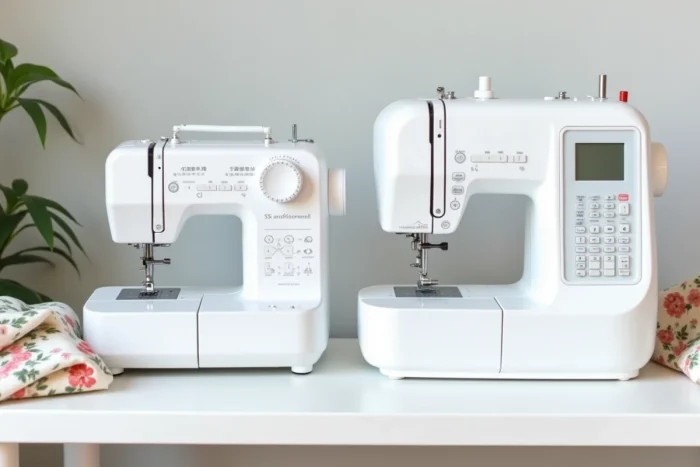
A mechanical machine is not simpler than an electronic one. This is a persistent misconception. On a mechanical model, the thread tension, stitch length, and width are adjusted manually via knobs. A misadjustment can easily go unnoticed and cause thread nests under the fabric.
An electronic machine automatically corrects the tension based on the selected stitch. It also offers a progressive speed control, allowing for slow sewing in curves without losing consistency. For a beginner, this is a concrete advantage in daily use.
The real criterion for choosing between mechanical and electronic lies in repairability. A mechanical model can be repaired by any technician with standard tools. A faulty electronic board on an electronic model can cost as much as the machine itself if the manufacturer does not guarantee the availability of parts.
Repairability and availability of spare parts
Since 2023-2024, brands like Bernina (through its Bernette b33/b35 range) and Janome explicitly state the availability of spare parts for 10 years, including for their entry-level models. This is a purchasing criterion to check before placing an order, especially for electronic machines.
A sewing machine that lasts a decade with regular maintenance (oiling, belt replacement) costs less than a succession of disposable models replaced every three years.
Useful sewing stitches on a beginner sewing machine: less is more
The 2024-2025 catalogs from Brother (revised A and J ranges) and Janome (3xx range) confirm a clear trend: recent models reduce decorative stitches in favor of practical functions. Automatic threading, one-step buttonholes, speed control – these are what truly accelerate learning.
A beginner practically uses a handful of stitches:
- The straight stitch, for all assembly seams on woven fabrics
- The zigzag stitch, for overlocking edges and sewing slightly stretchy fabrics
- The automatic buttonhole, which eliminates calculations and manual repositioning for each button
- The invisible hem stitch, useful from the first clothing or curtain projects
Beyond twenty stitches, we observe that additional stitches are rarely used in the first years of practice. It is better to have a machine with few stitches but good mechanics than a model packed with decorative stitches mounted on a fragile chassis.

Sewing machine budget: where to set the bar for a sustainable purchase
The price of a new sewing machine in France now includes the DEEE eco-contribution, applied since the consolidated reform in 2022 for electrical equipment. This eco-contribution represents a few euros on the receipt, but it mainly indicates that the machine enters an organized recycling circuit.
We distinguish three relevant purchasing levels:
- Entry-level mechanical, suitable for occasional projects on fine to medium fabrics, with a limited number of utility stitches
- Mid-range electronic, which adds speed control, automatic threading, and better tension management for regular use
- Mid-high range with rotary hook and reinforced chassis, intended for those who sew several hours a week and work with various materials
Second-hand sewing machine: an underestimated option
Mechanical machines from the 1990s-2000s from brands like Janome, Bernina, or Juki are regularly found on the second-hand market. A well-maintained second-hand mechanical model sews as well as a new entry-level one, often with a heavier and more stable chassis.
Before buying second-hand, we recommend checking three points: the condition of the belt, the play of the hook, and the smoothness of the fabric feed. A visit to an authorized technician for a check-up costs little and extends the machine’s lifespan by several years.
Ultimately, the choice of a sewing machine depends on the compatibility between the internal mechanism, the fabrics worked on, and the frequency of sewing. Prioritizing the quality of the hook and repairability over the number of stitches remains the best selection filter, regardless of the budget.