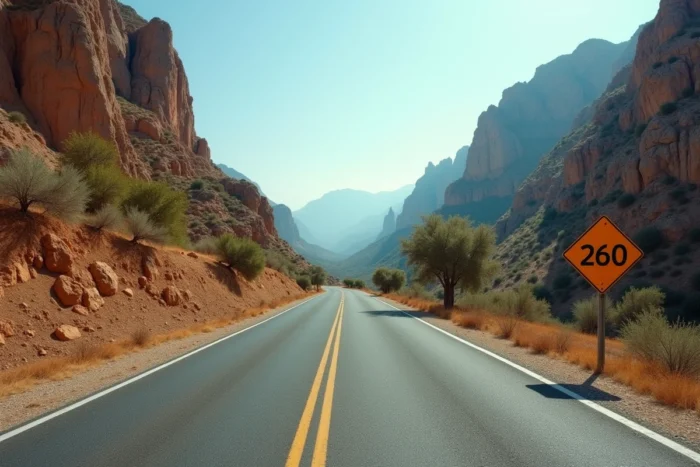
When driving from France to the Spanish Pyrenees, the N260 is often the first stretch where the asphalt begins to tell a different story than that of a highway. This national road crosses the southern slope of the Pyrenees from east to west, from Portbou near the Mediterranean to the Navarre border.
Built in the 1980s to connect previously isolated valleys, it remains today a route for both accessibility and travel. Its layout imposes a particular rhythm, consisting of chained passes, narrow sections, and crossings of villages where the road becomes the main street.
Closures and restrictions on the N260: what to check before leaving
On the most mountainous segments, the N260 is regularly affected by occasional closures. The Servei Català de Trànsit and the DGT report incidents related to landslides, falling rocks, and winter weather, sometimes extending into late spring.
There is a tendency to plan a Pyrenean road trip thinking only of visible weather (rain, snow). On this road, closures are more often due to the terrain than the sky: a landslide after a rainy episode, a slip that weakens a slope. These restrictions are not always reported on mainstream GPS applications.
The reflex to adopt: check the incident bulletins from the Spanish DGT on the morning of departure. Some sections between Cerdagne and Val d’Aran are more exposed than others, particularly the passages carved into the rock. When discovering the N260 in Spain with Partir Voyager, these logistical constraints are an integral part of the journey.
For motorcyclists, this sensitivity to geological hazards requires even more vigilance: gravel on corner exits, wet pavement under rocky overhangs, and sections without guardrails. Riding on the N260 is prepared like a hike, not like a highway trip.
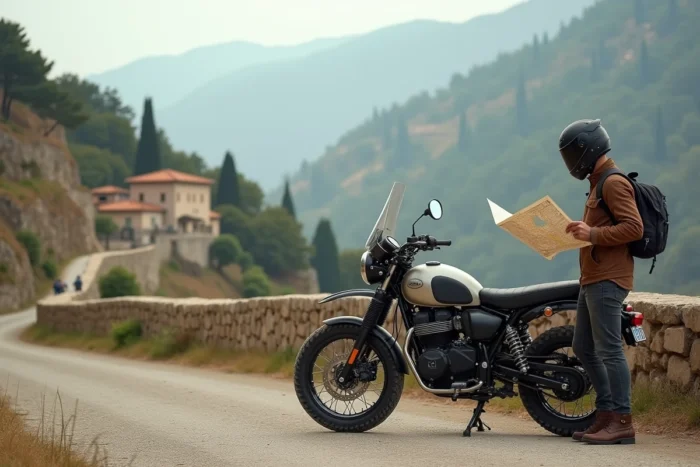
Sections of the N260 between the Pyrenees and the Mediterranean: which one to choose
The N260 does not offer the same experience along its entire length. The eastern section, between Portbou and Figueres, runs along low hills with views towards the Alt Empordà. The atmosphere is Mediterranean, the terrain moderate, and traffic flows more smoothly. It is driven to reach the coast or as a warm-up before the mountains.
The central segment: Cerdagne and Cadí-Moixeró
This is the heart of the route for those seeking Pyrenean landscapes. The road passes near the Cadí-Moixeró natural park, with sequences of valleys and passes that radically change the atmosphere every twenty kilometers. The turns are tight, the road narrow in places, and meeting a truck on certain stretches requires attention.
The western segment towards Aragon and Navarre
Past the Val d’Aran, the landscape opens up. The Aragonese Pyrenees offer a more mineral relief, with deep gorges and perched stone villages. This segment attracts many motorcyclists for its sequences of long curves and passes accessible for a good part of the year. Feedback varies on this point, as some passes remain closed late in the season depending on snowfall.
- Eastern segment (Portbou-Figueres): gentle terrain, ideal for a first day or a round trip from the Catalan coast
- Central segment (Cerdagne, Cadí-Moixeró): the most spectacular, but also the most demanding in terms of driving and weather
- Western segment (Val d’Aran, Aragon): wide open spaces, sweeping turns, the best choice for a multi-day motorcycle circuit
Parking constraints and protected areas near Cap de Creus
The eastern end of the N260 leads to the Cap de Creus area, one of the most protected coastal spaces in Catalonia. Environmental restrictions have tightened in recent years: wild parking is prohibited in several sectors around the natural park, and some informal access points to the coast have been blocked.
For those traveling in a van or camper, this is a constraint to integrate from the planning stage. The authorized areas are limited in number and quickly fill up in summer. Arriving late in the morning often means arriving too late.
By motorcycle or car, the problem is less severe, but official parking near Cadaqués or Portlligat remains small. Planning an early morning departure helps avoid saturation and enjoy the low light on the schist rock of the cape.
Preparing a motorcycle or car circuit on the N260: practical points
The N260 is not a road to be consumed in one go. Allowing several days to travel it entirely enables enjoying stops in the valleys without turning the trip into a marathon.
- Fuel: gas stations are spaced out on the central segment, particularly between Seu d’Urgell and Val d’Aran. Filling up at every opportunity avoids unpleasant surprises
- Accommodation: small valley hotels and rural lodges are numerous but fill up quickly in July-August. Book at least a few days in advance for key stops
- Motorcycle gear: even in summer, the Pyrenean passes impose marked temperature differences between the valley floor and high points. A waterproof layer in the top case is never superfluous
- Navigation: mobile network coverage is irregular in the most enclosed sections. Downloading offline maps before departure remains the most reliable solution
The local cuisine also deserves a stop. The valleys crossed by the N260, from Cerdagne to Aragon, offer generous mountain cuisine, often served in unpretentious inns but with quality local products.
The N260 remains above all a mountain road, built to open up valleys and not to attract tourists. This is precisely what gives it its character: no guardrails every ten meters, no developed viewpoints at every turn, just the asphalt, the terrain, and the rhythm that one chooses to impose.