
Choosing kitchen equipment involves making decisions between materials with very different properties, a wide range of prices, and an offer that evolves due to new regulations. The challenge is not to multiply accessories, but to target the pieces that truly influence cooking quality, durability, and everyday usability.
Pan and Pot Coatings: What the PFAS Regulation Changes
Most buying guides compare pans by their price or compatibility with induction cooktops. However, a less visible parameter weighs on the short-term offer: the restriction of PFAS in non-stick coatings. Several European countries (Denmark, Germany, Netherlands, Sweden, Norway) are pushing for a comprehensive restriction at the EU level on these per- and polyfluoroalkyl substances, according to the 2024 report from the European Environment Agency.
PFAS are the basis for coatings like PTFE (Teflon and equivalents). Their gradual restriction will reduce the availability of certain classic non-stick pans and promote alternatives: ceramic, raw cast iron, bare stainless steel, mineral iron. Before investing in a batch of cheap non-stick pans, checking the coating composition allows for anticipating regulatory obsolescence.
To delve deeper into the topic of materials and find comparisons suited to each use, Gourmandises et Cie’s advice details the technical criteria by product category.
Stainless Steel, Cast Iron, or Iron: Comparative Table of Cooking Materials
The choice of material determines thermal conductivity, maintenance, and longevity of a piece. UFC-Que Choisir highlighted, in several tests conducted between 2023 and 2024, that the performance gaps between a 20-euro pan and an 80-euro pan are sometimes minimal when the base material is the same. Price alone is therefore not a reliable indicator.
| Material | Thermal Conductivity | Maintenance | Durability | Induction Compatibility |
|---|---|---|---|---|
| Stainless Steel 18/10 | Average (requires aluminum or copper sandwich base) | Easy, dishwasher safe | Very long | Yes |
| Raw Cast Iron | Slow but even | Regular seasoning, no harsh detergent | Very long (several decades) | Yes |
| Mineral Iron | Fast, heats up quickly | Seasoning required, immediate drying | Long | Yes |
| Non-stick Aluminum (PTFE) | Fast | Very easy, fragile with metal utensils | Limited (coating wears out) | Variable (depending on base) |
| Ceramic | Average to fast | Easy, sensitive to thermal shocks | Average | Variable |
Cast iron and mineral iron require seasoning, but their lifespan more than compensates for the initial cost. In contrast, non-stick aluminum remains the simplest choice for delicate cooking (omelets, fish) as long as the coating is intact.
Kitchen Knives: Three Blades Are Enough
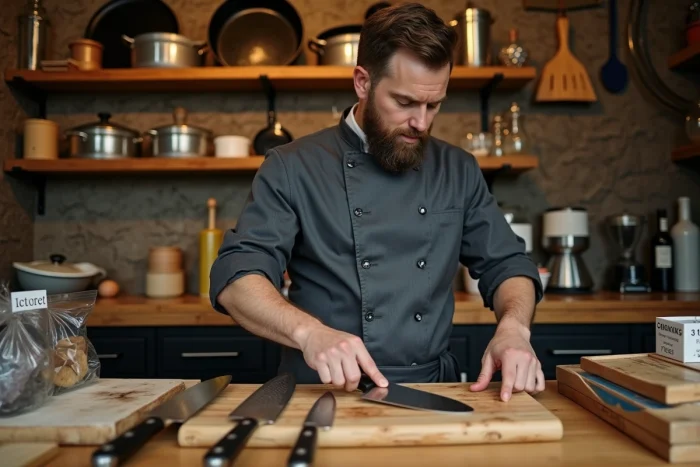
Knife blocks sold in sets of six to ten pieces look impressive in the display. In practice, a chef’s knife, a paring knife, and a bread knife cover almost all domestic cutting needs. Buying three quality blades instead of a complete entry-level block radically changes the comfort of preparation.
Stainless Steel or Carbon Steel
Stainless steel retains its sharpness for a shorter time but does not rust. Carbon steel offers a sharper cut and sharpens easily, but it oxidizes when in contact with moisture and acids (lemon, tomato). The choice depends on the maintenance frequency one is willing to accept.
A good quality indicator remains the Rockwell hardness (HRC) mentioned by the manufacturer. The higher it is, the longer the sharpness lasts, but the more specialized equipment is needed for sharpening (fine-grit stone rather than a standard honing rod).
Small Appliances: Durability vs. Gadget Effect
Ademe published a guide in 2023 on the environmental impact of domestic kitchen equipment. The main finding: the durability of a device weighs more on its carbon footprint than its energy class. Repairability, mechanical robustness, and availability of spare parts are the real criteria to examine before purchasing a food processor or blender.
- Check the repairability index displayed in stores (mandatory in France for certain categories), which rates the availability of parts and ease of disassembly.
- Prefer devices whose motors are guaranteed for several years and whose bowls, blades, and seals can be replaced separately.
- Avoid models whose accessories are exclusively proprietary and unavailable after a few years on the market.
The Cetelem Consumption Observatory 2024 also reports a notable increase in second-hand kitchen purchases, particularly for food processors and cast iron pots. This trend, driven by those aged 25-40, combines waste reduction and adaptation to rising prices of new items. Platforms like Le Bon Coin or the Emmaüs network regularly offer still-functional devices at a fraction of the retail price.
Everyday Utensils: Often Overlooked Criteria
Beyond the main pieces (pans, knives, appliances), common utensils – spatulas, whisks, cutting boards, molds – deserve attention on two specific points.
- Food-grade silicone utensils withstand high temperatures and do not scratch non-stick coatings, provided you choose platinum silicone rather than peroxide silicone, which is less stable at heat.
- Dense wood cutting boards (maple, beech) are more hygienic than one might think: the fibers of the wood trap bacteria that then die naturally, unlike scratched plastic where they proliferate in the grooves.
- Coated steel molds offer more consistent release than soft silicone, which tends to deform under the weight of heavy batters (cakes, terrines).
Each utensil replaced by a model better suited to the preparation process reduces time spent in the kitchen and limits handling accidents. The most effective approach remains to gradually build up equipment, replacing faulty pieces with tested alternatives, rather than buying a complete set where half ends up at the bottom of a drawer.