
A hollow-sounding wall behind the sofa, a hallway too dark to hang anything, a kitchen where every drawer sticks: before seeking inspiration on social media, it’s worth taking the time to identify what really hinders your interior.
Transforming your home on a daily basis doesn’t necessarily require a large budget or an architect. A few targeted interventions, chosen based on the actual constraints of each room, are often enough to change the atmosphere and comfort.
Reuse of furniture and materials: checks before decorating
Recovering a sideboard from a flea market or reusing old parquet boards is becoming increasingly appealing. These pieces are seen as a shortcut to a unique interior, and that’s true. The problem arises when nothing is checked before integrating them.
Recent recommendations encourage evaluating reuse based on technical criteria, not just aesthetic ones. Specifically, this means checking the structural condition of the furniture (drawers, hinges, top), its compatibility with current standards, the reparability of elements, and the availability of spare parts. A drawer with unfindable slides will quickly become a headache.
This approach transforms reuse into a real design process. We are no longer talking about a simple second-hand purchase placed in the living room, but a thoughtful selection that stands the test of time. To delve into this type of topic and find other concrete avenues, you can browse the home section of Autour 2 Moi, which gathers guides focused on housing.

Acoustics and flooring: a constraint often ignored by decor
Replacing carpet with parquet is one of the first reflexes when wanting to modernize a room. In a co-ownership or rental situation, this change can pose a real regulatory issue.
Replacing a flooring with parquet may require written consent from the landlord and adherence to the acoustic requirements of the co-ownership regulations. The consulted source specifically mentions a underlay with a minimum performance of 19 dB for impact noise insulation.
Before ordering anything, three things should be checked:
- The co-ownership regulations, which often impose a threshold for acoustic weakening for hard floors.
- The landlord’s agreement if renting, ideally in writing, even for works considered minor.
- The compatibility of the chosen underlay with the type of parquet (floating, glued) and the existing support.
Ignoring this point could force you to remove everything afterward, with the cost and frustration that entails. It’s better to think about it before investing in beautiful solid oak.
Energy Performance Certificate and thermal envelope: decorating before insulating, a common mistake
We repaint the walls, change the curtains, invest in a new sofa, and six months later, we discover that the housing is rated G on the energy performance diagnosis. Since January 1, 2025, properties rated G can no longer be offered for rent under a new lease, renewal, or tacit extension.
For landlord owners, this means that work on the thermal envelope, heating, and ventilation takes precedence over decoration. Applying a decorative coating on a poorly insulated wall is akin to masking the problem. Condensation will eventually damage the finish, and everything will need to be redone after insulation work.
Even for an owner-occupier, checking your EPC before starting a decor project prevents spending twice. First, address thermal bridges, ensure proper ventilation, and then decorate on a sound basis. It’s less appealing than a Pinterest mood board, but much more sustainable.
Statement pieces and understated furniture: lasting personalization
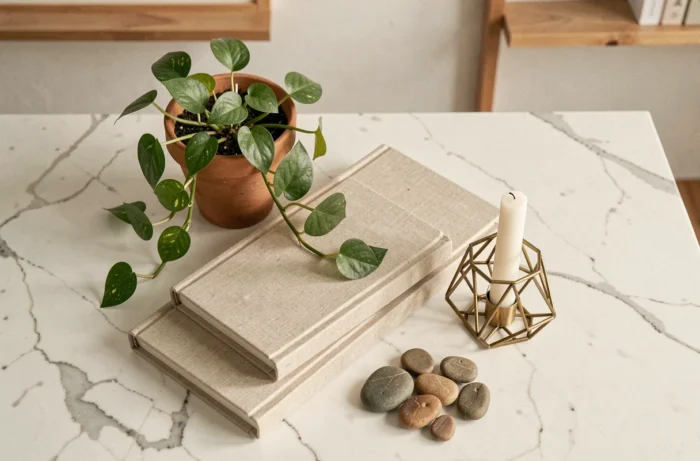
Recent trends in interior decoration are moving away from a total makeover of a room. We now favor one or two expressive elements paired with understated furniture, rather than renewing everything at once.
A sculptural piece with curved lines, a carefully sourced vintage item, or a remarkable material (walnut, terrazzo, natural stone) becomes the focal point of the living room or dining room. The rest of the decor remains neutral, allowing for a change in ambiance by replacing just one piece instead of dismantling everything.
Choosing your statement piece without error
The statement piece works when it contrasts with its immediate environment. A colorful velvet armchair stands out against a backdrop of white walls and light wood shelves. The same armchair, lost in a room already saturated with colors and textures, loses all its impact.
Here are a few criteria for selecting this piece:
- It should be visible as soon as you enter the room, not hidden in a blind spot.
- Its scale should match the volume of the room (a large sculptural piece in a 20 m² studio will overwhelm the space).
- It should withstand daily use: a fragile fabric on a seat used every day won’t last.
- Favor materials that age well (leather, solid wood, raw metal) over finishes that wear out quickly.
Opinions vary on this point, but an interior built around one or two statement pieces generally ages better than a decor conceived as a fixed ensemble. One can allow the decor to evolve gradually, without starting from scratch.
Light and storage: two underestimated levers for daily comfort
There is much talk about colors and furniture, but less about what truly changes life on a daily basis in a home: the quality of lighting and the accessibility of storage.
A living room with a single central ceiling light produces flat lighting that flattens the volumes. Multiplying sources (reading lamp, indirect wall light, discreet string lights) creates areas of shadow and light that add depth to the room without touching the paint or furniture.
On the storage side, the problem is almost never a lack of space. It’s the lack of accessibility. A deep closet where everything piles up is useless if you can’t see what’s inside. Open shelves at eye level, labeled boxes, an entryway piece with visible hooks: these details cost little and change the fluidity of daily life.

Beautifying your home on a daily basis is rarely a matter of trend or a spectacular budget. Transformations that stand the test of time stem from the actual constraints of the housing (acoustics, insulation, room volumes) and rely on choices of furniture and materials designed to last. A well-functioning interior is one where you don’t need to redo everything in two years.