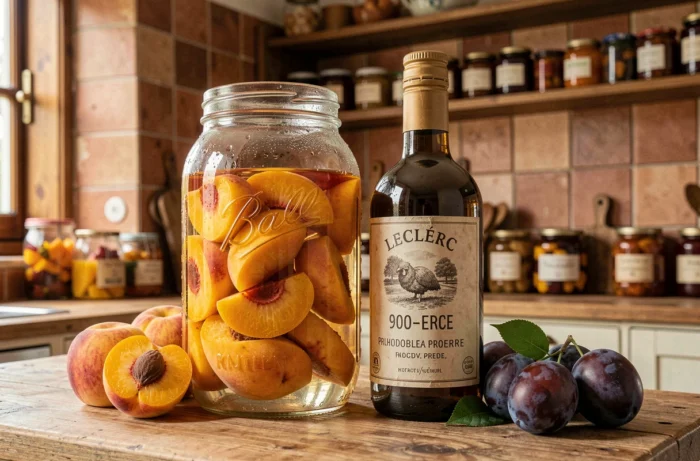
The 90° alcohol for fruits sold at Leclerc is not a unique product: depending on the stores, the referenced brand changes, the packaging varies, and the exact composition of the bottle differs. Consumer reviews reflect this heterogeneity more than a stable intrinsic quality. Understanding what lies behind the label helps to sort relevant feedback from misguided critiques.
Organoleptic profile of 90° ethyl alcohol and its impact on maceration
An alcohol with 90% vol. is a powerful solvent that extracts aromatic compounds from fruits very quickly. This efficiency has a downside: at 90°, the alcohol hardens the skin of the fruits and produces drier notes on the palate, especially with thin-skinned fruits like mirabelle or cherry.
Aromatic compounds soluble in water (some esters, organic acids) are less effectively captured at high degrees. A maceration at 40-55% vol. yields a rounder, fruitier profile. This is why many negative reviews of Leclerc’s 90° alcohol point to a result that is “too dry” or “lacking in fruit,” without the product being at fault: it is the degree itself that limits the taste result.
We recommend diluting the alcohol before bottling rather than after maceration. Pre-dilution with low-mineral water alters the extraction power from the start and preserves the texture of the fruit. Adding water at the end of maceration corrects the degree but not the already fixed aromatic profile.
Denaturants and food compliance: the true quality criterion
The majority of negative reviews stem from a confusion between household alcohol and food alcohol. A 90° bottle sold in the drugstore section contains denaturants (bitrex, methyl ethyl ketone) that render it unfit for ingestion. The food product, on the other hand, is a non-denatured ethanol subject to excise duties, which explains a significantly higher price for the same volume.
To verify that we are examining the quality of Leclerc’s 90° alcohol for fruits on a truly food-grade product, three mentions on the label should be checked first:
- The designation “agricultural origin ethyl alcohol” or “fruit alcohol,” never simply “modified alcohol” or “household alcohol”
- The absence of any denaturing agent in the ingredient list, including coded mentions (MEK, Bitrex, DEDB)
- The identification of the responsible operator, the batch, and the net volume, in accordance with European regulation INCO No. 1169/2011
A bottle lacking this information, even sold in a supermarket, does not fall under the food category. Several online reviews describe a “chemical” or “bitter” taste that typically corresponds to a denatured alcohol used by mistake.
Regulation 2019/787 and the gap between professional raw material and consumer bottle
The European regulation 2019/787 sets the characteristics of agricultural origin ethyl alcohol intended for spirit drinks. This standard imposes a minimum strength of 96% vol. and strict thresholds on impurities, notably methanol. The raw material used in professional distilleries is therefore much purer than the 90° bottle sold at retail.
The public 90° alcohol has already undergone dilution compared to this raw material. This dilution can introduce organoleptic variations depending on the quality of the water used and the storage conditions. Reviews mentioning differences from one batch to another at Leclerc find a technical explanation here: the final product depends as much on the dilution process as on the quality of the starting ethanol.
In practice, a well-formulated 90° food alcohol should not exhibit any marked residual odor or cloudiness in the bottle. Any opacity or visible deposit is a warning signal regarding storage conditions or production quality.
Storage in jars: temperature, duration, and the role of sugar
Opinions vary widely on the shelf life of fruits in alcohol. This divergence is explained by very different protocols from one user to another. Three parameters condition the longevity:
- The storage temperature must remain stable, ideally between 12 and 18 °C. Thermal variations accelerate oxidation and alter the color of the syrup
- The sugar/alcohol ratio acts as a co-preservative. Sugar lowers the water activity in the jar and slows microbial degradation, but an excess masks the fruit’s aromas
- The airtightness of the jar remains the most underestimated factor. A worn seal or a poorly tightened screw jar allows oxygen to enter, causing rapid browning and a flat taste even with good quality alcohol
Pear and mirabelle, fruits frequently jarred, react differently to maceration. Pears oxidize quickly and require rapid blanching before being placed in alcohol. The mirabelle, more resistant, can undergo direct maceration but loses its golden color if the temperature exceeds the recommended threshold.
Maceration duration and final alcohol degree
A 90° alcohol diluted to about 50-55% vol. before maceration yields a balanced result after two to three months of resting. At pure 90°, the same maceration time produces a result too marked by ethanol. Reducing the degree before bottling significantly improves the final result, a point rarely specified in online reviews.
Variable availability at Leclerc and alternatives to consider
The range of food alcohol at 90° varies from one Leclerc to another. Some stores only list household alcohol, while others offer a food-grade bottle in the spirits or fine grocery section. This irregularity generates frustration in reviews, as a customer redirected to the cleaning aisle sometimes unknowingly buys the wrong product.
When the food product is absent from the shelf, pharmacies sometimes offer non-denatured ethyl alcohol by order. Agricultural cooperatives and specialized distillation equipment websites are other reliable sources, with labeling generally more precise than that of supermarket bottles.
The most reliable reviews on Leclerc’s 90° alcohol for fruits are those that specify the purchase aisle and the exact mention on the label. Without this information, a negative review may concern a household product used by mistake, which skews any quality comparison.