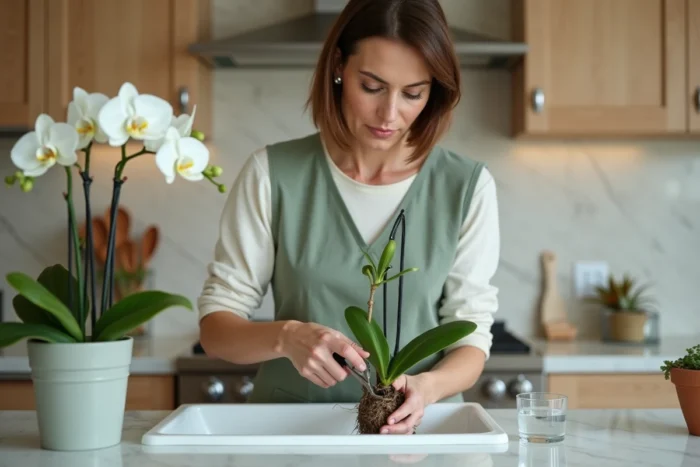
Your orchid has lost all its flowers, its stem is dry, and its leaves are wilting. Before you throw it away, check one specific point: the plant may simply be dormant. In the case of Phalaenopsis, the most common indoor species, apparently dry tissues can remain alive for several months after the leaves have fallen. Knowing the difference between a dead orchid and a dormant orchid changes everything for what comes next.
Dead orchid or dormant: check the meristem before taking action
The meristem is the growth area located at the base of the plant, between the roots and the collar. As long as this small core of cells is not necrotic, the plant can regrow. Research from Wageningen University in the Netherlands confirms that in Phalaenopsis, cellular activity persists in this area even when the orchid appears dead on the surface.
To check, gently scratch the bark at the base of the collar with a fingernail or the tip of a clean knife. You are looking for green or white tissues beneath the surface. If everything is brown, dry, and crumbly underneath, the plant is probably lost.
Also examine the roots. Healthy roots are firm, green or silver in color. Brown, soft, and spongy roots indicate advanced rot. However, if you find even just two or three firm roots among the others, it is entirely possible to easily revive a dead orchid with the right actions.
- Green or white tissues under the collar: the plant is dormant, not dead
- Silver and firm roots: the root system is still functioning
- Presence of a small green bud at the base of a leaf or on the stem: sign of possible recovery
Rotten roots on an orchid: clean and treat the substrate
When roots rot, the problem often comes from a decomposed substrate that retains too much water. The pine bark used in orchid pots degrades over time and eventually becomes compact. Air can no longer circulate, and the roots suffocate.
Remove dead roots without hesitation
Take the orchid out of the pot and remove all the old substrate. Using disinfected scissors, cut away each soft, brown, or hollow root. Keep only the firm roots. Even if there are only two or three left, that is enough to restart the plant.
Oxygenate with diluted hydrogen peroxide
This technique, documented by the Union Fleurs et Plantes of the Netherlands (VBN) in its sustainable cultivation sheets, remains little known to the general public. 3% hydrogen peroxide diluted in watering water releases oxygen upon contact with the substrate. It limits the fungi responsible for rot and helps the surviving roots to regrow.
Soak the cleaned roots in this solution for a few minutes. Allow them to air dry before repotting. This soak acts as a mild disinfectant, without burning the living tissues.
Repotting for recovery: substrate and pot suitable for a weakened orchid
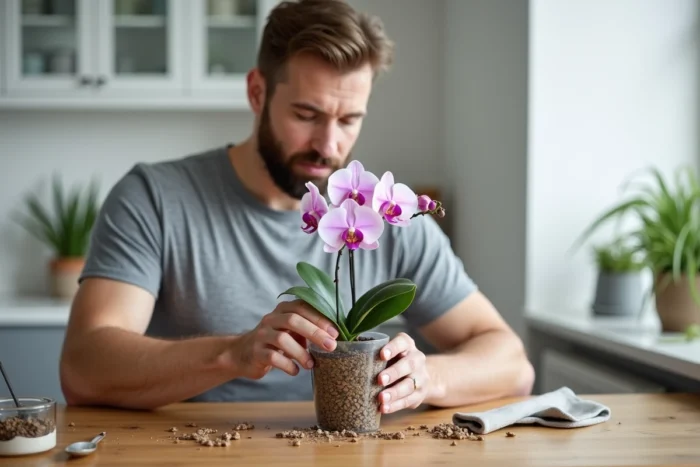
The choice of pot and substrate has more impact on your orchid’s survival than the frequency of watering. A transparent pot allows you to monitor the condition of the roots daily without handling the plant. You can see the color of the roots and the moisture of the substrate at a glance.
In recent years, professional growers have recommended a mix of sphagnum and pine bark for recovering orchids. Sphagnum maintains a constant humidity around the weakened roots, while the bark ensures drainage and air circulation.
Have you noticed that orchids in garden centers are often in pure bark? This is suitable for healthy plants, but a weakened orchid needs a more protective substrate during its recovery phase. Place a thin layer of moist sphagnum around the remaining roots, then fill in with bark.
Watering and temperature to restart an orchid’s flowering
A recovering orchid should not be treated like a healthy orchid. Watering should be spaced out and adapted to the condition of the roots.
The safest method: immerse the pot in a container of water for about fifteen minutes, then let it drain completely. The substrate should dry out between waterings. Check with your finger or by observing the roots through the transparent pot. Silver roots: the plant is thirsty. Green roots: wait.
The role of temperature difference
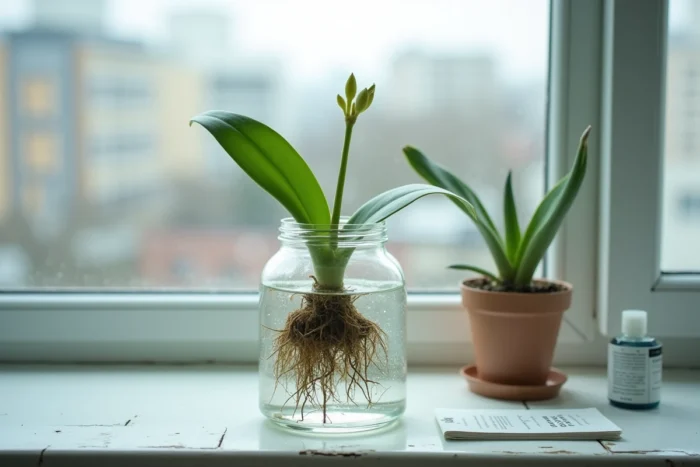
To stimulate a new flower spike, the orchid needs a temperature difference between day and night. Place it near a bright window (without direct sunlight) where the temperature naturally drops in the evening. This thermal difference mimics tropical conditions and triggers flowering in Phalaenopsis.
- Abundant indirect light, never direct sunlight on the leaves
- Cooler nighttime temperature than daytime temperature
- No standing water in the saucer or at the bottom of the pot
- Keep the orchid away from dry heat sources (radiator, oven)
Recovery takes time. Several weeks, sometimes a few months, before you see a new leaf or a young root appear. An orchid that produces a new leaf is on the right track, even if flowering comes much later. Patience is part of the process: as long as the collar remains green and the roots are developing, the plant is recovering at its own pace.