Artistic photography in Belgium is evolving within a rapidly changing legal and technological framework. The implementation of new European obligations regarding the transparency of images generated by artificial intelligence is reshaping the definition of what it means to “create” a photograph. This regulatory context coexists with a dense network of galleries, collectives, and active photographers between Brussels, Liège, Ghent, and Antwerp.
Transparency and AI: What the AI Act Changes for Artistic Photography in Belgium
As of August 2, 2026, Article 50 of the European AI Act requires clear labeling of visual content that misleadingly represents real people, places, or events. Deepfakes are the primary target, but the measure also affects photographers who blend shooting and algorithmic generation.
For a Belgian artistic photographer, the question arises as soon as a retouching goes beyond simple adjustments of light or contrast. Creating a synthetic character, adding a generated element into a real landscape, or merging multiple shots using an AI model: these practices potentially fall under the obligation of transparency.
Field feedback on this point varies. Some creators believe that generative retouching is merely an extension of darkroom work. Others argue that as soon as an AI model is involved in the image-making process, the viewer has the right to know. The available data does not yet allow for a clear distinction between traditional retouching and manipulation that requires disclosure.
A portfolio published on eyes-wide-shoot.be illustrates this coexistence between analog approach and digital exploration, where each series questions the boundary between image capture and construction.
Traceability of Visual Sources: A Blind Spot in Belgian Law
Beyond transparency to the public, a second question emerges: that of the traceability of the elements that compose an image. When a photographer trains a model on their own archives, the legal question remains simple. It becomes more complicated when open databases, such as LAION, serve as raw material.
Several ongoing procedures in Europe concern the use of protected photos to train AI models without the authors’ consent. The distinction between stylistic inspiration and the use of recognizable elements from a protected work becomes a concrete issue for hybrid series that blend photography and algorithmic generation.
For Belgian artistic photographers, this gray area has practical consequences:
- A gallery owner exhibiting a hybrid series may be asked about the provenance of the visual elements, which implies rigorous documentation of the creative process
- A photographer selling prints must be able to attest that the generated components do not reproduce an identifiable work of a third party
- Photography competitions and awards are beginning to require a declaration regarding the use of AI tools in the creation process
Documenting each step of the creative process is becoming a practice of both legal and artistic protection.
Galleries and Exhibition Spaces: The Belgian Art Photography Network
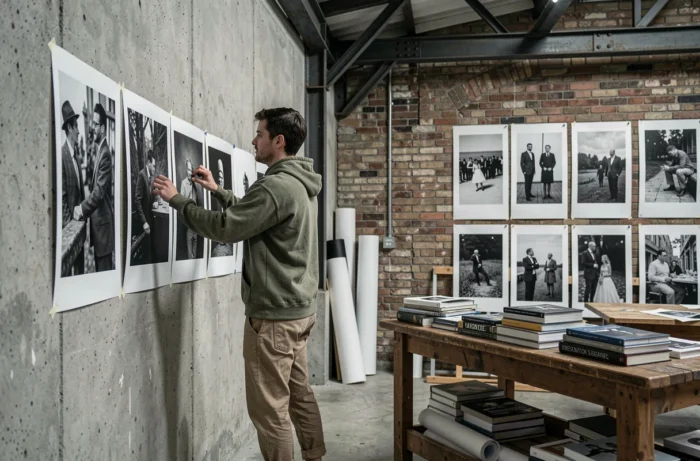
Belgium has a network of places dedicated to photography that extends beyond the Brussels-Antwerp axis. Spaces like the Museum of Photography in Charleroi anchor the discipline in a long history. In Brussels, several private galleries regularly program black and white series or documentary works that question the Belgian urban landscape.
This network operates differently from the Parisian or London markets. The proximity between artists and gallery owners facilitates collaborations on experimental formats: large prints, installations combining image and sound, narrative series designed for specific hangings.
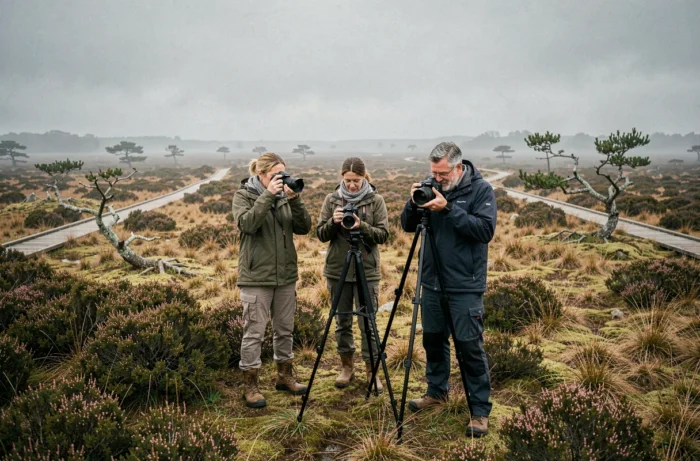
Collectives also play a structuring role. Rather than working solo, many Belgian photographers come together to share production costs, organize collective exhibitions, and negotiate residencies. This cooperative model, less visible than the gallery system, carries a significant portion of contemporary photographic creation in Wallonia and Flanders.
Black and White, Landscape, Portrait: The Genres in Circulation
Landscape photography remains a highly practiced genre in Belgium, driven by the diversity of light between the coast, the Ardennes, and the Flemish plains. The work on natural light in black and white constitutes a recurring signature among Belgian photographers exhibited internationally.
Artistic portraiture and street photography also hold a notable place. Documentary series on daily life in Belgian cities find an audience at the intersection of art and visual journalism, with particular attention to print quality and the choice of exhibition format.
Online Distribution and Image Rights: The Limits to Know
Publishing images on social media or a personal website does not exempt one from respecting image rights, which are particularly strict in Belgium. Photographing a recognizable person in public space and disseminating the image without consent exposes one to legal action, even in an artistic context.
Belgian image rights protect any recognizable person, including in artistic street photography. Exceptions exist (current events, crowds where no individual is isolated), but they are interpreted restrictively by the courts.
For photographers who sell prints or exhibit in galleries, the question of consent is compounded by that of rights transfer. A model photographed for an artistic series can contest the commercial use of their image if the initial contract only provided for gallery dissemination.
- Formalize in writing the scope of use for each portrait, even for a non-commercial project
- Distinguish online distribution (social media, personal website) from the sale of prints, which falls under a different regime
- Keep the original permissions, as the burden of proof lies with the photographer in case of dispute
Belgian artistic photography navigates between a strong documentary heritage, an active gallery scene, and regulatory constraints that are tightening with the advent of AI. The challenge for photographers is no longer just to master light and framing, but to understand the legal framework in which their images circulate.