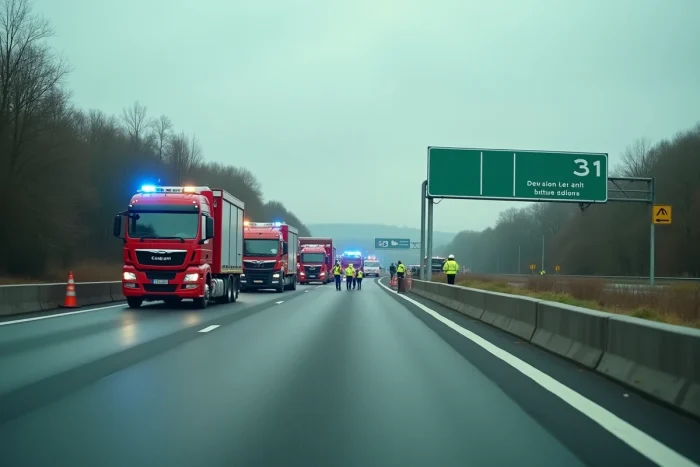
An accident on the A31 causes major disruptions and mobilizes emergency services. On this motorway linking Lorraine to Luxembourg, serious collisions have increased in recent years, driven by ever-denser cross-border traffic. Understanding what happens during such an event, from the initial alert to the reopening of the lanes, helps to grasp why some accidents paralyze traffic for hours.
Cross-border traffic on the A31: a constantly pressured route
The A31 is not just any motorway. It handles a considerable daily flow of cross-border workers commuting between Moselle and Luxembourg. This volume of vehicles, which has been steadily increasing since the post-Covid recovery, creates tense traffic conditions, especially during peak hours.
Road safety reports from the Moselle prefecture and the DREAL Grand Est indicate a rising trend in personal injury accidents on the northern A31. The proportion of accidents involving users commuting to work in Luxembourg is particularly notable.
When an accident occurs on an already saturated route, the domino effect is immediate. A lane blocked for an hour can create traffic jams spanning several dozen kilometers, affecting not only the motorway but also the surrounding secondary roads. Find details of the accident on the A31 today to gauge the extent of the ongoing disruptions.
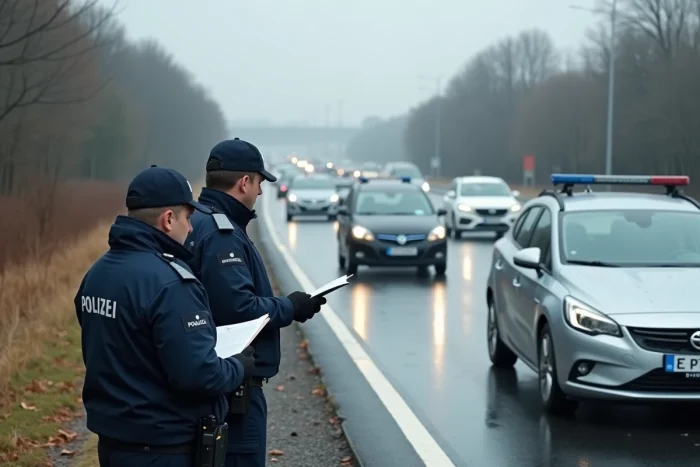
Emergency intervention on the motorway: why the A31 complicates everything
Have you ever noticed that some accidents seem to take hours to clear? On the A31, the difficulty of access for emergency services is a recurring and documented problem.
Congestion blocks emergency vehicles
Firefighters from Moselle and Meurthe-et-Moselle have reported in recent interviews that traffic congestion delays the arrival of emergency services on the Metz-Woippy and Nancy-Metz sections. The emergency corridor, the lane that drivers must create between traffic lines, rarely forms smoothly when the road is already congested.
Several factors exacerbate the situation:
- The absence of a continuous hard shoulder on certain sections reduces the clearance zones for accident vehicles and emergency services.
- The road profile, with closely spaced interchanges in the Metz urban area, prevents quick detours of traffic flow.
- Blocked motorists sometimes attempt to turn around or use the shoulders, further obstructing access for rescue teams.
The typical intervention chain
In the event of a serious accident on the motorway, the alert is raised by emergency call boxes, the motorway control center, or calls to 17 or 112. The departmental operational center then simultaneously activates firefighters, the SAMU, and law enforcement.
On the A31, patrols from the Interdepartmental Roads Directorate (DIR Est) play a first-response role. They secure the area by setting up signage before the arrival of medical assistance. This safety phase can take several tens of minutes when traffic is heavy.
A31 action plan: public measures to reduce accidents
Today’s accident does not occur in a political vacuum. Since 2023-2024, an A31 action plan has brought together the State, the Grand Est Region, and the Lorraine departments around targeted measures for the safety of this route.
This plan includes the development of interchanges on the most accident-prone sections, the implementation of dynamic speed management, and modernization works. The Metz-Woippy sector is among the identified priority areas.
Why this choice? Because dynamic speed management, meaning real-time adjustment of speed limits according to traffic, reduces speed differentials between vehicles. It is precisely these differentials that cause rear-end collisions, one of the most common types of accidents in congested areas.
Articles discussing accidents on the A31 often present these tragedies as isolated events. In reality, they are part of a structural trend linked to the growth of cross-border traffic that this plan seeks to contain.
Traffic disruptions after an accident on the A31: what to expect
A serious collision on the A31 triggers a predictable sequence. Understanding it helps to adapt your travel plans.
The partial or total closure of the lane occurs as soon as the first emergency services arrive. In the Metz-Luxembourg direction, this closure can last several hours if the prosecutor orders on-site judicial investigations. The clearance of accident vehicles and the cleaning of the roadway (debris, fluids) adds even more time.
Detour routes generally go through parallel national roads, but these poorly absorb the surplus of vehicles. The result: the municipalities crossed experience a sudden congestion that can last as long as the motorway closure itself.
- Check the variable message signs before entering the A31, as they indicate ongoing closures.
- Navigation apps often redirect to roads unsuitable for the volume of diverted traffic, which can lengthen the journey instead of shortening it.
- In the event of a prolonged closure, exits before the accident zone become saturated themselves. Anticipating by exiting well in advance remains the most reliable strategy.
The complete restoration of traffic after a serious accident rarely takes less than two to three hours. When the accident involves deceased victims and a judicial investigation, this delay can double.
The frequency of these events on the A31, combined with the lack of a viable alternative motorway between Metz and Luxembourg, places this route in a situation that the planned improvements will not resolve overnight. Daily commuters on this road know: each trip carries an element of unpredictability linked to traffic density and the vulnerability of the infrastructure.