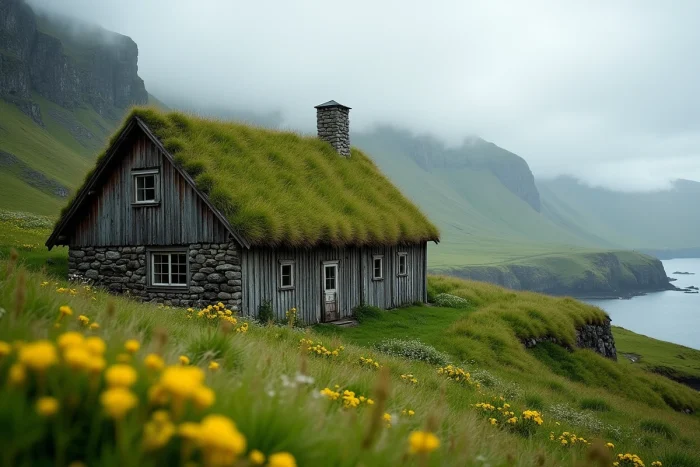
In the Faroe Islands, houses literally carry the earth on their backs. This layer of green grass on the roofs is not a decorative whim. It results from specific climatic constraints, a craftsmanship passed down since the Viking era, and a renewed interest linked to recent climate policies. Understanding how a Faroese grass roof works means grasping a complete technical system, much more sophisticated than a simple lawn laid on boards.
Structure of a Faroese grass roof: what lies beneath the lawn
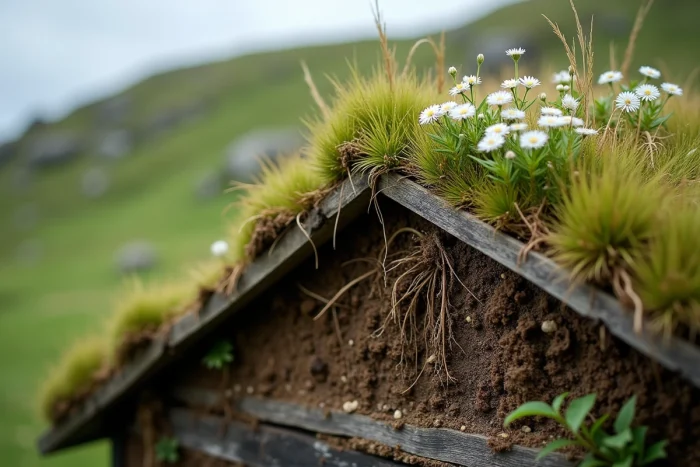
You see a uniform green surface from the road. Beneath this grass, several stacked layers ensure the waterproofing and strength of the roof. The base rests on a wooden frame, often made from driftwood recovered from the coasts, as the archipelago has virtually no forests.
On this frame, boards form a rigid support. Next comes birch bark, traditionally used as a waterproof membrane. This bark, imported from Norway or Iceland, blocks water infiltration while allowing the wood to breathe.
The next layer is peat. Cut into blocks, it is laid in two crossed thicknesses: one grassy side facing down, and another grassy side facing up. This crossing prevents water from finding a direct path inside. Grass naturally grows in the upper layer, and its roots consolidate the whole structure. You can learn more about Zlati Constructions to understand the details of this architectural phenomenon.
Each layer serves a specific function, from waterproofing to insulation. Removing a single element compromises the entire system.
Thermal insulation and wind resistance: why grass outperforms other materials in the archipelago
Why not simply lay tiles or slate? In the Faroe Islands, winds regularly exceed speeds capable of tearing off rigid roofing elements. The heavy and flexible vegetated peat absorbs gusts instead of resisting them head-on.
The weight of the peat stabilizes the roof against Atlantic storms. This simple mechanical principle explains the longevity of this technique in such a hostile environment.
Thermal insulation is the other direct advantage. The layer of earth and grass creates a buffer that slows heat exchange. In winter, the house retains its internal warmth better. In summer, when temperatures rise slightly, the vegetated roof limits overheating.
This dual function, protection against wind and natural insulation, has made grass roofs more suitable than any imported material for centuries. Traditional Faroese houses, often low and compact, maximize this effect by reducing the surface exposed to the elements.
Restoration of traditional roofs: the guidelines from the National Museum of the Faroe Islands
Over time, some homeowners have replaced their grass roofs with modern materials. To curb this disappearance, the National Museum of the Faroe Islands published technical guidelines in 2022 for homeowners wishing to restore their traditional houses.
These rules mandate the use of local peat and regulate the roof slope. They also limit the use of synthetic membranes to preserve the authenticity of the building. The thickness of the vegetative layer is subject to specific recommendations, as a roof that is too thin dries out quickly and loses its insulating properties, while a roof that is too thick overloads the frame.
These guidelines address a delicate balance. Improving waterproofing without distorting the historical appearance requires measured technical choices. Birch bark remains preferred, but its supply depends on Scandinavian imports, complicating large-scale restoration.
Faroese green roofs and climate strategy: recent subsidies and experiments
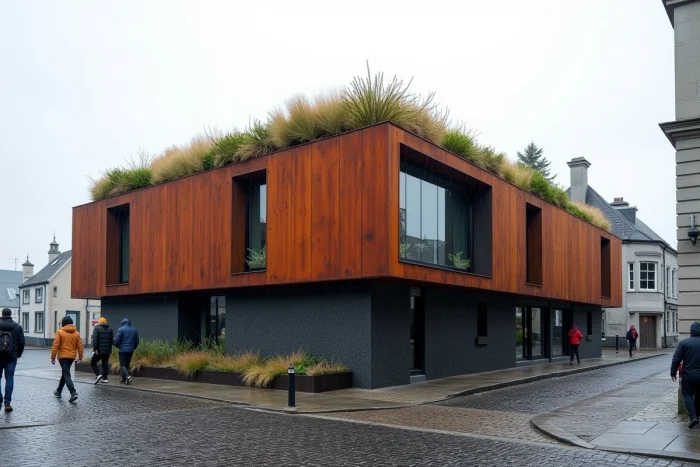
The Faroese government has integrated green roofs into its carbon neutrality strategy. The Faroese climate policy, updated in 2022 by the Ministry of Environment, Industry and Trade, provides subsidies for energy renovation and tax relief for works classified as “green renovations.”
Maintaining a traditional grass roof grants access to public financial aid. This mechanism encourages homeowners to preserve or restore these roofs rather than replace them with industrial coverings.
Meanwhile, Faroese and Icelandic architects have been testing new plant mixtures since 2023. The idea is to combine pasture grasses and cliff mosses to enhance the roofs’ resistance to extreme rain events and strong winds. These pilot projects have been documented by the Nordic Council of Ministers in a report on nature-based solutions in Nordic habitats, published in 2023.
- Pasture grasses provide a deep root system that stabilizes the peat layer and resists wind uprooting.
- Cliff mosses retain surface moisture, limiting erosion during intense rainfall.
- The combination of the two creates a denser vegetation cover, reducing long-term maintenance interventions.
These experiments show that Faroese tradition is not static. It evolves by integrating current botanical knowledge to respond to intensifying climatic conditions.
Maintenance of a grass roof: what mowing really changes
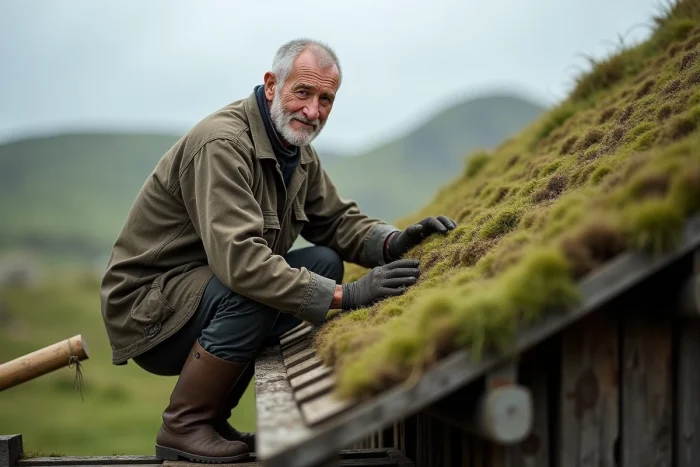
A grass roof is not self-sufficient. Without maintenance, tall grasses absorb too much moisture, weigh down the structure, and encourage the growth of unwanted plants whose roots penetrate the waterproof layers.
Regularly mowing the roof preserves the balance between vegetation and structure. Mowing controls the height of the grass, limits the weight on the frame, and prevents woody species from establishing. Some homeowners still use sheep for this task, a method that feeds local folklore but is still practiced on a few rural buildings.
Inspecting the birch bark or the underlying membrane is also part of the maintenance cycle. An undetected crack leads to infiltrations that degrade the frame in just a few seasons. The guidelines from the National Museum recommend an annual check, ideally before autumn, when rains intensify.
The grass roofs of the Faroe Islands are neither picturesque nor anecdotal. They embody a technical response to a harsh climate, now supported by public policies and botanical research. For travelers crossing the archipelago, each green roof tells a story of geographical constraint transformed into a sustainable solution.