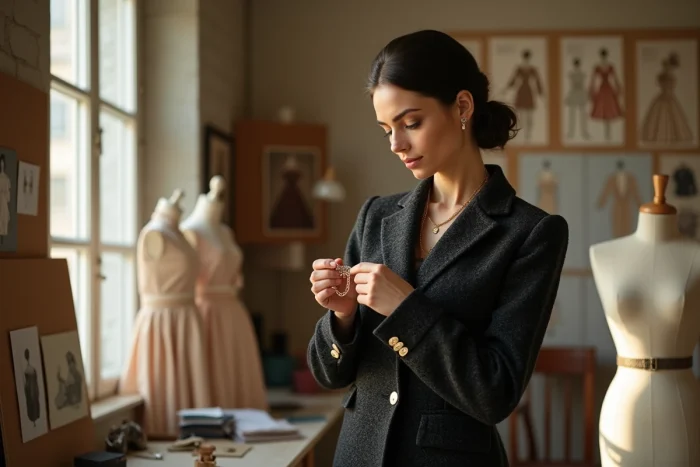
Coco Chanel had neither children nor biological descendants. The question of perpetuating her legacy in contemporary fashion does not go through a classic family lineage, but through a set of distinct actors: the historical owners of the house, the successive artistic directors, and the muses chosen to embody her codes. Comparing the roles and levers of each allows us to measure what, concretely, keeps the Chanel legacy alive in contemporary fashion.
Wertheimer Ownership and Chanel Artistic Direction: Two Roles, Two Levers
The Chanel house has never belonged solely to Gabrielle Chanel. The Wertheimer family has owned Chanel since the 1920s, a unique case among the major French luxury houses where the founder’s name and the owner’s name do not coincide.
This distinction between capital ownership and creative direction has structured the entire recent history of the brand. The table below compares the two functions that perpetuate the Chanel legacy.
| Criterion | Wertheimer Family (owners) | Artistic Directors |
|---|---|---|
| Nature of the role | Capital ownership, financial strategy, asset management | Creation of collections, reinterpretation of codes |
| Public visibility | Very low (almost no media appearances) | Very high (fashion shows, interviews, media) |
| Relationship to Chanel codes | Conservation through investments (workshops, Métiers d’art) | Seasonal reinterpretation (tweed, camellia, gold chains) |
| Duration of influence | Several continuous generations | Variable depending on mandates |
| Link with Gabrielle Chanel | Commercial partnership from the beginning | Aesthetic and symbolic filiation |
To delve deeper into the subject, the descendants of Coco Chanel and their legacy deserve careful reading as the confusion between biological heirs and cultural heirs remains common.
The Wertheimers remain among the most discreet families in the luxury world. Their strategy relies on strict control of the brand without personal exposure, unlike the Arnault or Pinault families who assume a public role.
Chanel Heritage Strategy: Foundations, Métiers d’art, and Exhibitions
The legacy of Gabrielle Chanel is not limited to ready-to-wear or haute couture collections. The Wertheimer family explores an artistic territory that is still little exposed, through acquisitions of works, support for exhibitions, and funding of cultural foundations.
This heritage dimension goes beyond clothing. It anchors the brand in a broader cultural narrative, where most SERP competitors focus on Gabrielle’s biography or on Karl Lagerfeld.
- The Métiers d’art workshops (Lesage embroidery, Lemarié featherwork, Massaro shoemaking) have been acquired and preserved by Chanel to ensure the transmission of French artisanal know-how directly linked to Gabrielle’s creations.
- Regular museum exhibitions (from the Palais Galliera in London) place original Chanel pieces in a historical context, outside the commercial circuit.
- Support for contemporary artistic projects allows the house to associate with current creators without reducing the legacy to a vintage catalog.
This positioning distinguishes Chanel from competing houses that perpetuate the legacy of a founder primarily through collections. At Chanel, perpetuation comes as much from intangible heritage as from the product.
Dynastic Muses and the Chanel Legacy: Charlotte Casiraghi and the New Ambassadors
Since the early 2020s, Chanel has strengthened a specific communication axis: choosing ambassadors from cultural or aristocratic dynasties rather than simple models. Charlotte Casiraghi, granddaughter of Grace Kelly, embodies this strategy. Present on the front lines of fashion shows, she wears iconic pieces like the white shirt or the tweed suit.
This choice is not trivial. By associating the brand with women from prestigious lineages, Chanel updates the figure of Gabrielle as a woman of power and network. The parallel works: Coco Chanel mingled with the European aristocracy and the intellectual circles of her time. Today’s muses extend this narrative without copying it.
What This Choice of Muses Changes in Brand Perception
The use of “dynastic” figures repositions the Chanel legacy on a register that goes beyond clothing fashion. The ambassador does not sell a product; she embodies a cultural filiation. Charlotte Casiraghi evokes a tradition of independent and media-savvy women, which directly resonates with the values of emancipation championed by Gabrielle Chanel.
However, this approach carries a risk: that of freezing the house’s image in an aristocratic exclusivity distant from the international clientele that today represents the majority of luxury purchases. The balance between European heritage and global openness remains a constant arbitration for the brand’s management.
Post-Lagerfeld Artistic Direction: What Weight for the Chanel Legacy in Current Collections
Karl Lagerfeld led the Chanel studio for over three decades. His departure raised a structuring question for the house: Can Gabrielle’s legacy survive without a creative director so closely identified with the brand?
The response outlined by Chanel consists of distributing the creative function rather than concentrating it on a single personality. Virginie Viard ensured the transition for several seasons before the house engaged in new reflections on creative direction.
This model breaks with the dominant pattern in French luxury, where a “star” artistic director personifies the house (Hedi Slimane at Celine, Demna at Balenciaga). At Chanel, the bet is the opposite: the brand takes precedence over the creator, which makes Gabrielle’s legacy more autonomous from the individuals who interpret it.
This particularity also explains why the Chanel house continues to operate with very stable visual codes (tweed, camellia, gold chain, black and white) where other houses reinvent their identity with each change of direction. Chanel’s aesthetic stability is less a conservatism than a deliberate long-term transmission strategy, driven by the Wertheimers much more than by an individual creator.
The legacy of Coco Chanel is perpetuated today through a three-pillar architecture: an invisible but decisive owning family, a heritage policy that goes beyond clothing, and muses chosen for their symbolic filiation. No biological descendant in this equation, but a transmission system that, so far, functions without major disruption.